Why Standard Catalog BLDC Motors Fail in High-Torque Industrial HVAC: The Hidden "Compatibility Tax"
Published on July 6, 2026
Why Standard Catalog BLDC Motors Fail in High-Torque Industrial HVAC: The Hidden "Compatibility Tax"
In heavy-duty industrial HVAC and large-scale ventilation systems, components are routinely pushed to their engineering limits. When dealing with high-torque applications—especially those requiring geared motors delivering torque outputs above 50Nm—reliability and system efficiency are paramount.
Yet, many procurement teams and system engineers fall into a costly trap: selecting Brushless DC (BLDC) motors straight out of a standard product catalog.
While the catalog approach promises convenience and lower upfront unit costs, it frequently results in systemic performance shortfalls. In the industrial HVAC sector, forcing a standard catalog motor into a complex, high-load system triggers what we call the "Compatibility Tax." Here is a deep dive into why off-the-shelf solutions fail under high-torque industrial demands and how parameter-driven engineering eliminates this hidden operational drain.
The Illusion of the Catalog Standard
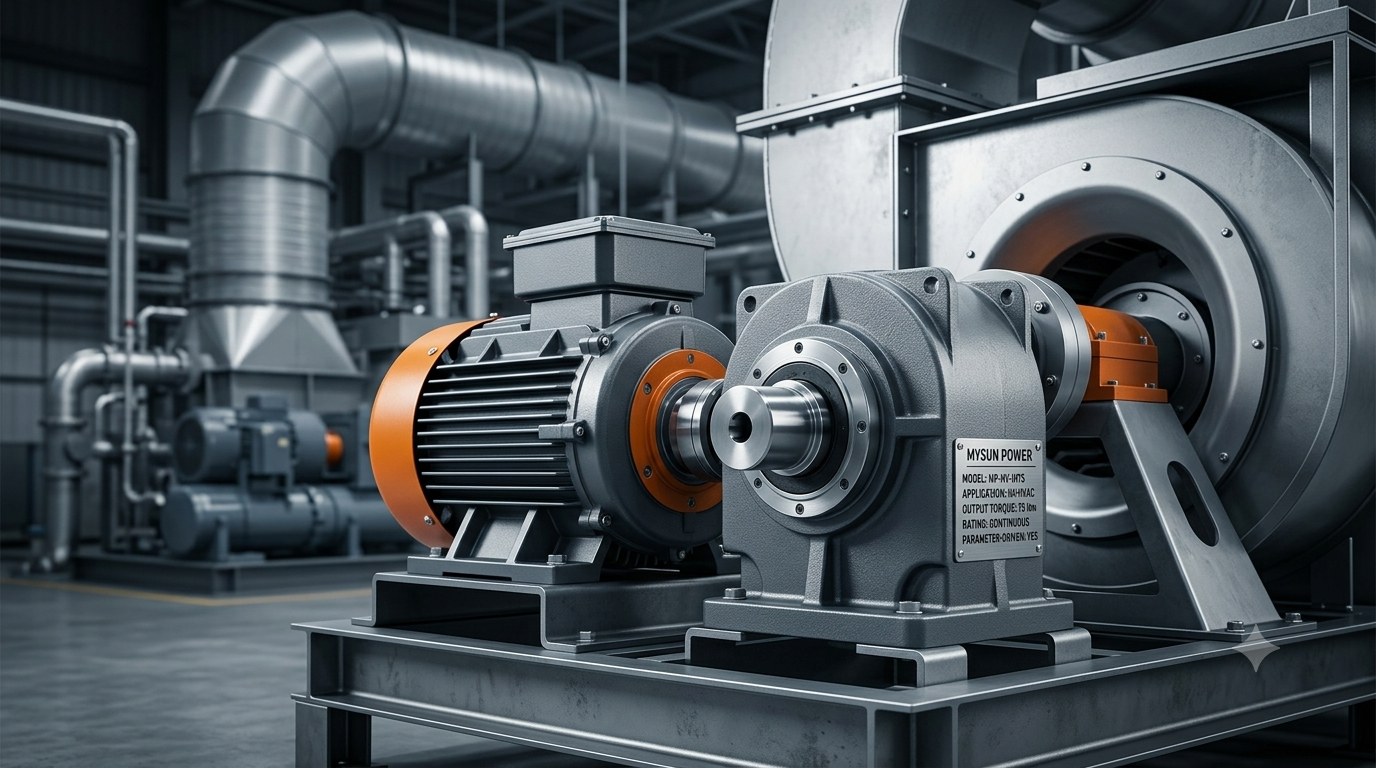
On paper, a standard catalog BLDC motor might appear to meet your basic voltage, power, and nominal torque requirements. However, industrial HVAC systems do not operate in a textbook environment. Heavy-duty fans, industrial air handlers, and high-torque geared reduction drives operate continuously under harsh, dynamic loads.
When a standard motor is integrated into these heavy systems, several critical misalignments typically occur:
Sub-optimal Torque-Speed Curves: Standard motors are designed for average applications. Under heavy industrial loads, they often fail to deliver peak efficiency at the precise operating points required by your specific centrifugal fan or gearbox configuration.
Thermal Dissipation Failure: High-torque continuous operation generates immense thermal stress. Catalog motors lack the customized housing or tailored electromagnetic optimization required to dissipate heat effectively within the specific physical confines of your air-handling unit.
Mechanical Stress Amplification: For applications exceeding 50Nm, the mechanical interface between the motor shaft and the gear reducer must be flawless. Minor misalignments in catalog specifications lead to micro-vibrations, accelerated bearing wear, and premature gearbox failure.
Demystifying the "Compatibility Tax"
What exactly is the Compatibility Tax? It is the financial and operational penalty an organization pays when it attempts to make a standard component fit a specialized, high-performance system.
When you buy a standard catalog BLDC motor, you are not saving money; you are simply delaying your expenses. The Compatibility Tax manifests in your day-to-day operations through:
Deteriorating System Efficiency: If the motor does not operate at its peak efficiency sweet spot for your specific industrial airflow requirements, it consumes excess power. Over a 24/7/365 industrial operating cycle, this extra power consumption dwarfs any initial savings on the purchase price.
Engineering Workarounds: Your engineering team spends valuable hours designing custom brackets, adding external cooling systems, or modifying software controllers just to make the catalog motor compatible with the actual industrial application.
Unplanned Downtime: In heavy industries or manufacturing facilities, HVAC failure is not an inconvenience—it is a production halt. Catalog motors forced into high-torque environments suffer from higher failure rates, driving up maintenance overheads.
Shifting Focus: From Unit Cost to Total Cost of Ownership (TCO)
In professional industrial B2B procurement, the upfront component price is a deceptive metric. To protect your domestic assets and maximize business efficiency, the focus must shift entirely to Total Cost of Ownership (TCO) reduction.
The TCO Formula in Industrial HVAC: > TCO = Initial Purchase Price + Installation & Modification Costs + Lifetime Energy Consumption + Maintenance & Downtime Costs
By choosing a customized, system-optimized BLDC powertrain over a catalog standard, the initial acquisition cost may adjust, but the lifetime energy consumption and maintenance costs drop drastically. Eliminating the Compatibility Tax through precise engineering integration can reduce the overall TCO of an industrial HVAC system by 15% to 30% over its operational lifespan.
The Solution: Parameter-Driven Matching
To eliminate the Compatibility Tax and optimize your power system, the engineering process must be Parameter-Driven. Rather than forcing your system to adapt to a pre-existing motor catalog, the motor and electromagnetic system must be tailored precisely to your application’s strict boundary conditions.
At MYSUN POWER, we reject standard catalog sales for high-torque applications. We believe that a truly optimized power system requires a comprehensive evaluation of the application's unique operational envelope.
Before engineering a heavy-duty HVAC BLDC solution, technical alignment must be established across core boundary fields, including:
Electrical Boundaries: Exact bus voltage fluctuations, peak current constraints, and specific controller modulation frequencies.
Mechanical Interfaces: Precise shaft dimensions, load configurations, radial/axial forces, and gear reduction ratios for outputs above 50Nm.
Thermal and Environmental Limits: Actual ambient operating temperature ranges, airflow velocity across the motor enclosure, and IP rating requirements for harsh industrial dust or moisture exposure.
Conclusion: Stop Buying From Catalogs. Start Matching Parameters.
High-torque industrial HVAC systems demand specialized power systems, not generic solutions. Relying on standard catalog BLDC motors risks your system's efficiency and guarantees a heavy Compatibility Tax.
By embracing a parameter-driven matching philosophy, industrial operators can unlock true power system optimization, eliminate engineering headaches, and achieve significant, measurable reductions in TCO.