Beyond Initial BOM Cost: Evaluating Commercial Motor TCO
Published on July 6, 2026
When reviewing a new product’s Bill of Materials (BOM), the executive eye naturally gravitates toward the unit price of core components like Brushless DC (BLDC) motors. Procurement teams are often praised for shaving a few dollars off this initial acquisition cost. However, treating a commercial motor as a one-time transaction is a severe strategic miscalculation.
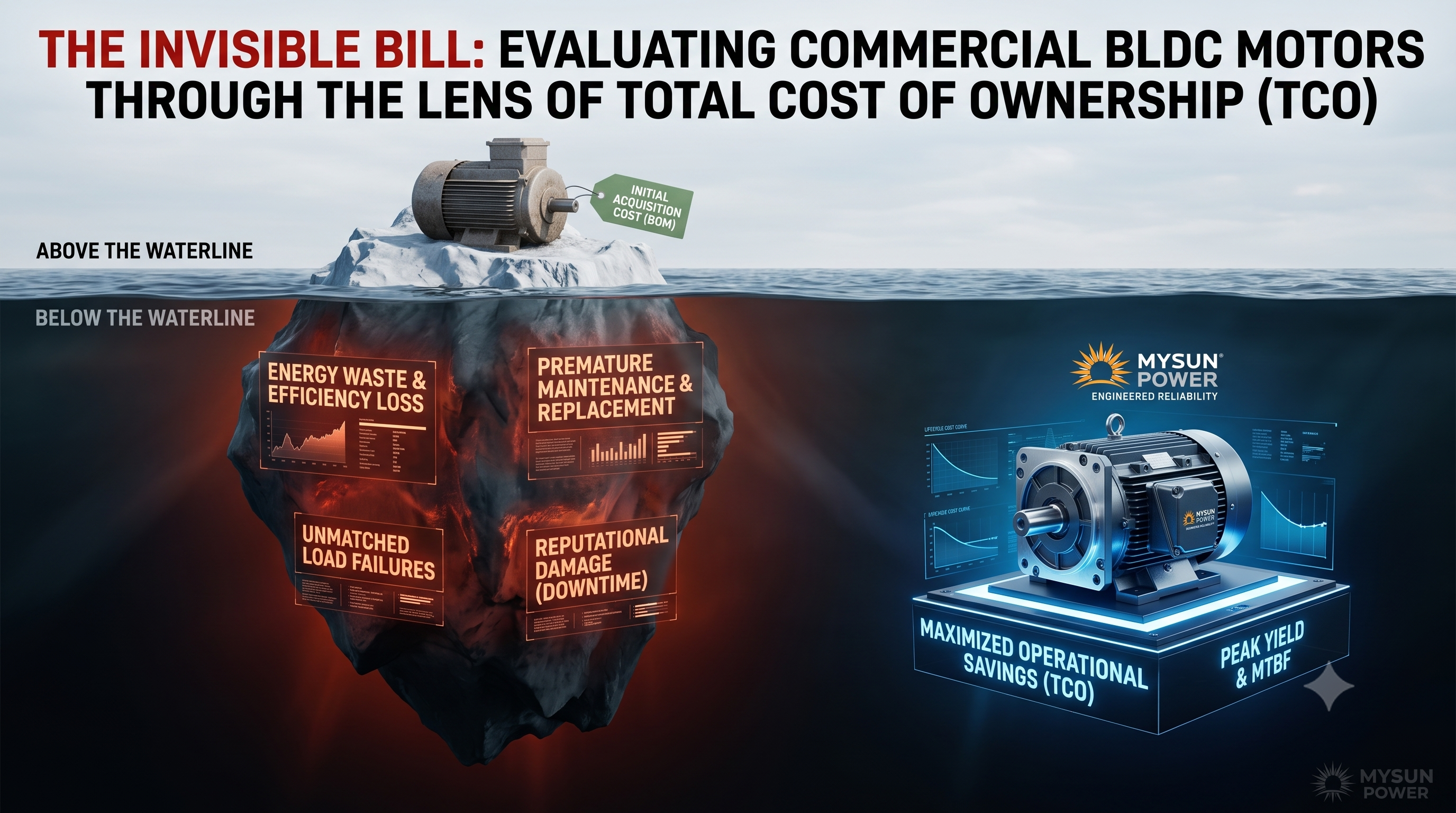
The initial price tag is merely the tip of the iceberg. Beneath the surface lies the "Invisible Bill"—the long-term expenses that drain your operational budget (OPEX) and erode your brand's reputation. To accurately assess the financial impact of a motor, you must evaluate it through the lens of Total Cost of Ownership (TCO).
The Illusion of the "Cheap" Motor
A standard, off-the-shelf motor might look attractive on a spreadsheet today, but it is effectively a high-interest loan. You pay less upfront, but you compound your costs over the lifespan of the equipment.
A comprehensive TCO model for industrial and commercial motors incorporates four distinct pillars:
1. Initial Acquisition Cost (The Distraction) This is the BOM cost. It is the easiest metric to measure, but often represents less than 10% of the motor's total lifecycle cost in heavy-duty commercial applications like HVAC or deep-sea robotics.
2. Operational Lifecycle Cost (The Silent Killer) This is the cost of energy. If a standard motor operates at 82% efficiency, while a custom-matched motor operates at 92%, that 10% delta translates into massive electrical waste over a 24/7 duty cycle. Over a five-year operational span, the energy savings from a high-efficiency motor will often exceed the initial purchase price of the motor itself multiple times over.
3. Maintenance and Replacement Cost Standard motors forced into non-standard applications suffer from accelerated wear. Bearings degrade faster due to unmatched radial loads, and coils overheat due to poor thermal integration. The TCO skyrockets when you factor in the labor costs of frequent maintenance, premature component replacement, and processing warranty claims.
4. The Cost of Downtime (The Reputation Killer) What is the financial impact when a commercial precision air conditioner fails in a server room? What is the cost of retrieving an ROV from the ocean floor because a thruster motor burned out? Equipment downtime destroys SLA (Service Level Agreement) compliance and permanently damages client trust. This is the most expensive, yet least quantified, component of the Invisible Bill.
Customization as a Financial Strategy
At MYSUN POWER, we approach motor design as a financial strategy for our clients. By utilizing parameter-driven integration, we engineer motors that are perfectly matched to your system's exact load profiles, thermal boundaries, and duty cycles.
The result?
Peak Efficiency: Drastically lowering the operational energy costs.
Extended MTBF (Mean Time Between Failures): Eliminating premature mechanical and electrical degradation.
Zero "Compatibility Tax": Removing the R&D and assembly redundancies.
Stop Buying Hardware, Start Investing in Yield
For CEOs, CFOs, and strategic decision-makers, the mandate is clear. Stop allowing procurement to make long-term reliability decisions based solely on short-term BOM savings. Demand a TCO analysis. When you calculate the true lifecycle cost, investing in a high-efficiency, custom-engineered BLDC motor is not an added expense—it is the most aggressive cost-reduction strategy available to your supply chain.