
Supply Chain Efficiency in 2026: Why OEMs are Shifting to Custom Motor Integrators
Published on July 6, 2026
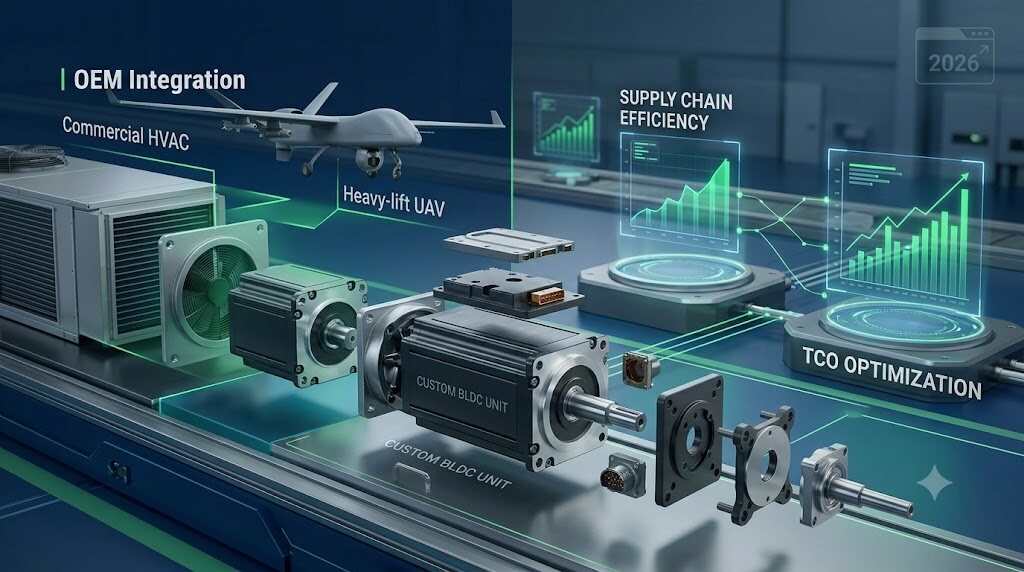
Sourcing standard "off-the-shelf" components has long been the default choice for procurement departments looking to minimize upfront costs.
However, as global manufacturing enters a more demanding phase, Original Equipment Manufacturers (OEMs) in highly specialized sectors—such as commercial HVAC, Unmanned Aerial Vehicles (UAVs), and Remotely Operated Underwater Vehicles (ROVs)—are discovering that standard catalog Brushless DC (BLDC) motors often carry heavy hidden financial burdens.
Today, forward-thinking manufacturing executives and engineering leads are pivoting away from standard suppliers. Instead, they are turning to specialized custom motor integrators who design around precision parameters to secure a definitive edge in supply chain efficiency.
The Hidden "Compatibility Tax" of Standard Motors
When an OEM purchases a standard catalog motor, the product design must often be compromised to accommodate the component's fixed specifications. This structural mismatch introduces several operational liabilities that quickly erode any initial purchasing savings:
Secondary Engineering Bottlenecks: Engineering teams frequently waste valuable R&D hours designing custom mounting plates, coupling systems, or additional thermal management extensions just to make a standard motor fit the application enclosure.
Assembly Line Delays: Non-optimized components increase assembly complexity, leading to longer production cycle times, specialized labor requirements, and a higher risk of error on the shop floor.
Elevated Quality Risks: Operating a standard component close to its maximum functional limit inherently reduces overall product lifespan, leading to unexpected warranty claims and higher Return Merchandise Authorization (RMA) rates.
The Power of Parameter-Driven Integration
In contrast to component catalog sellers, a dedicated custom motor integrator follows an application-first, parameter-driven integration framework. By aligning the electromagnetic, mechanical, and electronic components into a single calibrated system, OEMs unlock deep operational advantages.
1. Optimized Electrical & Mechanical Profiles Whether your project requires precise torque-speed curves for residential ventilation fans, specialized KV ratings for heavy-lift tactical UAVs, or high-pressure sealing mechanisms for subsea ROV propulsion, every component is integrated to meet the exact operational stresses of your application. This eliminates the need for any secondary mechanical adaptations on your side.
2. True Plug-and-Play Assembly Custom integration ensures that the motor arrives with tailored shaft configurations, application-specific wiring harnesses, and perfectly matched Electronic Speed Controllers (ESCs) supporting your exact communication protocols (e.g., CAN bus, PWM, or Modbus). This streamlines your internal production lines, drastically reducing final assembly hours.
3. Factory-Level Verification & Streamlined Quality Control By partnering with an integrated manufacturer, OEMs receive fully assembled and rigorously tested drive units. This consolidates your testing protocols; instead of conducting separate incoming quality checks for motors, shafts, and controllers, your team performs a single inspection on a unified module, radically simplifying inventory management.
Securing the Strategic Edge
In the business-to-business sector, true supply chain efficiency extends far beyond negotiating the absolute lowest unit cost. True efficiency is measured by faster time-to-market, flawless out-of-the-box reliability, and responsive factory support.
Transitioning to a parameter-driven BLDC motor integration strategy allows OEMs to safeguard their production schedules and significantly lower their ultimate Total Cost of Ownership. Finding an agile manufacturing partner capable of aligning reliable production timelines, rigorous factory testing, and flexible Minimum Order Quantities (MOQs) is the definitive step toward robust supply chain optimization.