Why Standard IP67 Motors Fail at 300m: The Hidden "Compatibility Tax" in ROV Design
Published on July 6, 2026
The Deep-Sea Reality Check: Why IP67 is Not Enough
In the world of Subsea ROVs (Remotely Operated Vehicles), failure is measured in thousands of dollars per hour of downtime. Many engineering teams attempt to adapt standard industrial BLDC motors with an IP67 rating for underwater use. While IP67 is rated for temporary immersion up to 1 meter, it is fundamentally incapable of handling the crushing pressures at 300 meters or beyond.
The Trap of Secondary Sealing
To compensate for standard motor vulnerabilities, engineers often design bulky secondary pressure housings. This approach seems cost-effective at first, but it introduces the "Compatibility Tax":
Excessive Weight: Oversized housings increase the vehicle's footprint and decrease the power-to-weight ratio.
Thermal Bottlenecks: Air gaps inside secondary housings insulate the motor, leading to overheating during sustained high-torque thruster operations.
Seal Fatigue: Standard lip seals fail under the dynamic pressure cycles found in deep-sea environments.
Defining the ROV "Compatibility Tax"
At MYSUN POWER, we define the Compatibility Tax as the wasted engineering hours, material costs, and lost efficiency incurred when trying to "ruggedize" a motor that wasn't built for the mission. Integrating a non-specialized motor into a subsea powertrain requires complex gearboxes and risky secondary seals that eventually leak.
The Solution: Parameter-Driven IP68 Integration
True subsea reliability requires a parameter-driven approach. Instead of building around a motor, the motor should be engineered for the environment:
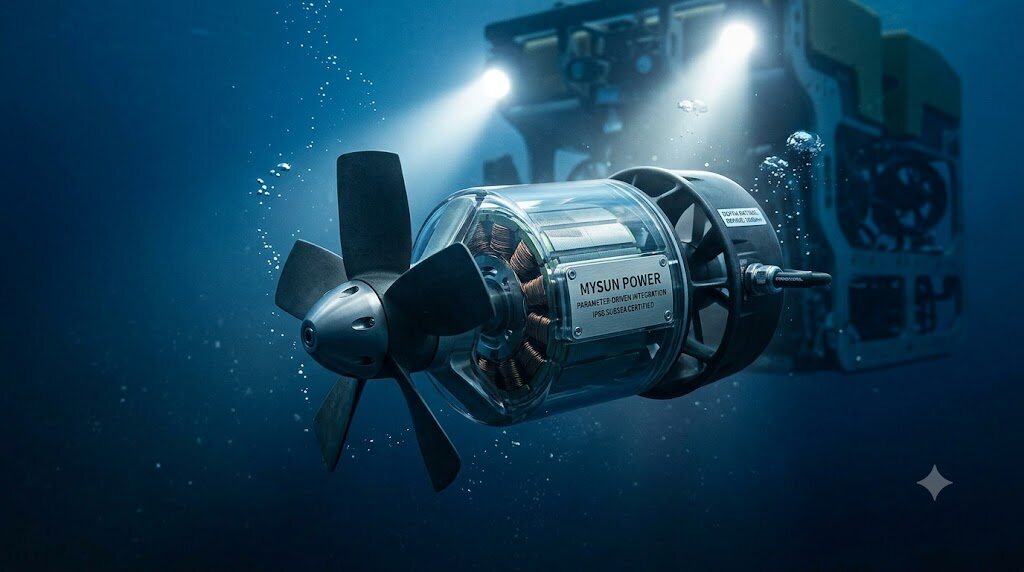
IP68/IP69K Direct Immersion: Our motors are engineered for continuous immersion, utilizing specialized potting resins and SS316 marine-grade housings.
PBOF (Pressure-Balanced Oil-Filled) Technology: For depths exceeding 500m, we offer PBOF integration to equalize internal and external pressure, ensuring zero-leak performance.
Hydrodynamic Matching: By customizing the KV and torque curve to your specific thruster propeller, we eradicate the need for heavy gearboxes, significantly improving battery life and vehicle agility.
Stop Compromising on Deep-Sea Missions
If you are still designing your ROV around standard motor catalogs, you are paying a heavy compatibility tax. It is time to shift to application-specific powertrain integration.