Beyond Standard Thrust: Thermal Management in Next-Gen Heavy-Lift UAV Motors
Published on July 6, 2026
In the defense and industrial UAV sectors, raw thrust numbers on a datasheet are no longer the ultimate metric for mission success. As payloads increase and mission profiles demand prolonged hovering or aggressive vertical climbs, the true bottleneck shifts from aerodynamic peak thrust to dynamic thermal management.
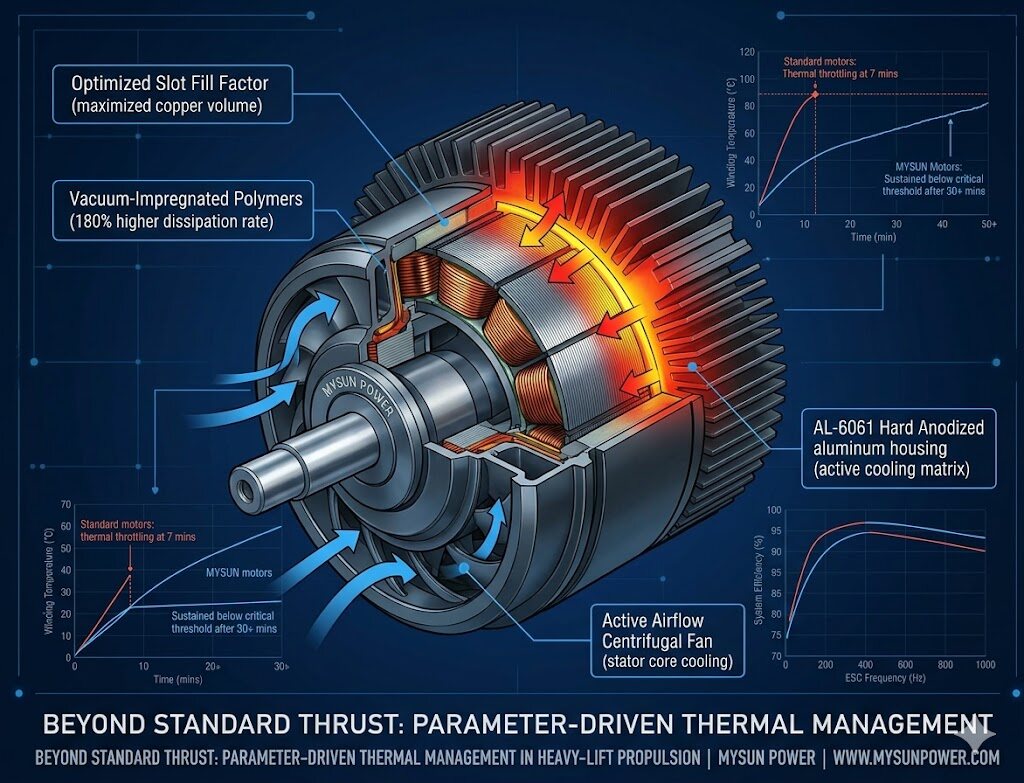
Standard, off-the-shelf brushless (BLDC) motors often suffer from severe thermal throttling within 5 to 7 minutes of continuous high-load deployment. This phenomenon is rarely an aerodynamic failure; it is a fundamental thermodynamic limitation caused by what we call the "Compatibility Tax"—relying on generic catalog motor windings that force the electronic speed controller (ESC) to operate outside its optimal frequency, resulting in massive parasitic heat generation.
The Anatomy of Thermal Throttling in Heavy-Lift Propulsion
When a heavy-lift UAV (typically 25kg to 100kg+ MTOW) operates under sustained peak current, internal winding temperatures can rapidly exceed 120 degrees Celsius. At these elevated thresholds, two catastrophic events occur:
Magnetic Degradation: High-grade Neodymium (NdFeB) permanent magnets begin to suffer reversible—and eventually irreversible—demagnetization, permanently reducing the motor's torque constant (Kt).
I2R Losses: As the copper wire temperature rises, its electrical resistance increases linearly. This creates a destructive feedback loop—higher resistance generates more heat, which further raises resistance, drastically dropping the overall system efficiency.
The MYSUN Approach: Parameter-Driven Mitigation
At MYSUN POWER, we approach heavy-lift UAV motor architecture from a clean-sheet perspective. We eliminate the compatibility tax by synchronizing the motor’s phase resistance and inductance precisely with the specific switching topology of the client’s ESC.
Rather than overloading the motor with heavy, passive aluminum heatsinks that compromise the aircraft's power-to-weight ratio, we utilize three core engineering interventions:
Optimized Slot Fill Factor: Through precision orthocyclic winding techniques, we maximize the volume of copper within the stator slots. This reduces the primary copper losses (I2R) at the source and provides a cleaner path for conductive heat transfer from the core to the outer housing.
Advanced Vacuum-Impregnated Polymers: Our stators undergo high-pressure vacuum impregnation using custom-formulated, high-thermal-conductivity epoxy resins. This fills all microscopic air pockets within the windings, increasing the internal thermal dissipation rate by up to 180% compared to standard dip-coated motors.
Aerodynamic Stator Architecture: The structural housing of our heavy-lift motors features integrated centrifugal fan geometries within the rotor base. This forces ambient airflow directly through the stator core during high-RPM rotation, creating an active cooling matrix without adding external payload weight.
Engineering for Continuous Duty Cycles
The goal of modern UAV propulsion is not just to lift the payload, but to sustain it predictably under volatile environmental conditions. By shifting the paradigm from catalog sourcing to parameter-driven design, MYSUN POWER allows heavy-lift platforms to maintain a steady-状态 thermal profile well below critical thresholds, even during continuous-duty multi-hour missions.
For clean-sheet architects developing the next generation of industrial or tactical unmanned systems, the conclusion is clear: do not design your airframe around a catalog motor limit. Force the motor to align with your engineering logic.