How High-Efficiency BLDC Motors Maximize IE4/IE5 Energy Compliance in Commercial HVAC Systems
Published on July 8, 2026
Introduction
Regulatory frameworks worldwide, such as the European Union’s ErP Directive and international IE4/IE5 efficiency standards, are placing unprecedented pressure on commercial Heating, Ventilation, and Air Conditioning (HVAC) manufacturers. As commercial buildings aim for net-zero carbon emissions, components within ventilation drives, variable air volume (VAV) boxes, and air handling units (AHUs) must undergo massive efficiency overhauls.
For decades, traditional AC Induction Motors (ACIM) have been the industry workhorse. However, when subjected to modern variable-speed requirements and strict eco-design mandates, they are rapidly reaching their physical efficiency limitations. To overcome these barriers, upgrading to high-efficiency Brushless DC (BLDC) motors has transitioned from a premium design choice to a regulatory necessity.
---
1. The Physics of Efficiency: Why AC Motors Struggle at Part-Load
To understand the core design bottleneck, we must look at the rotational physics of standard AC induction motors. An ACIM relies entirely on electromagnetic induction to induce a current in the rotor. This process inherently generates permanent rotor copper losses ($I^2R$ losses) and core excitation losses.
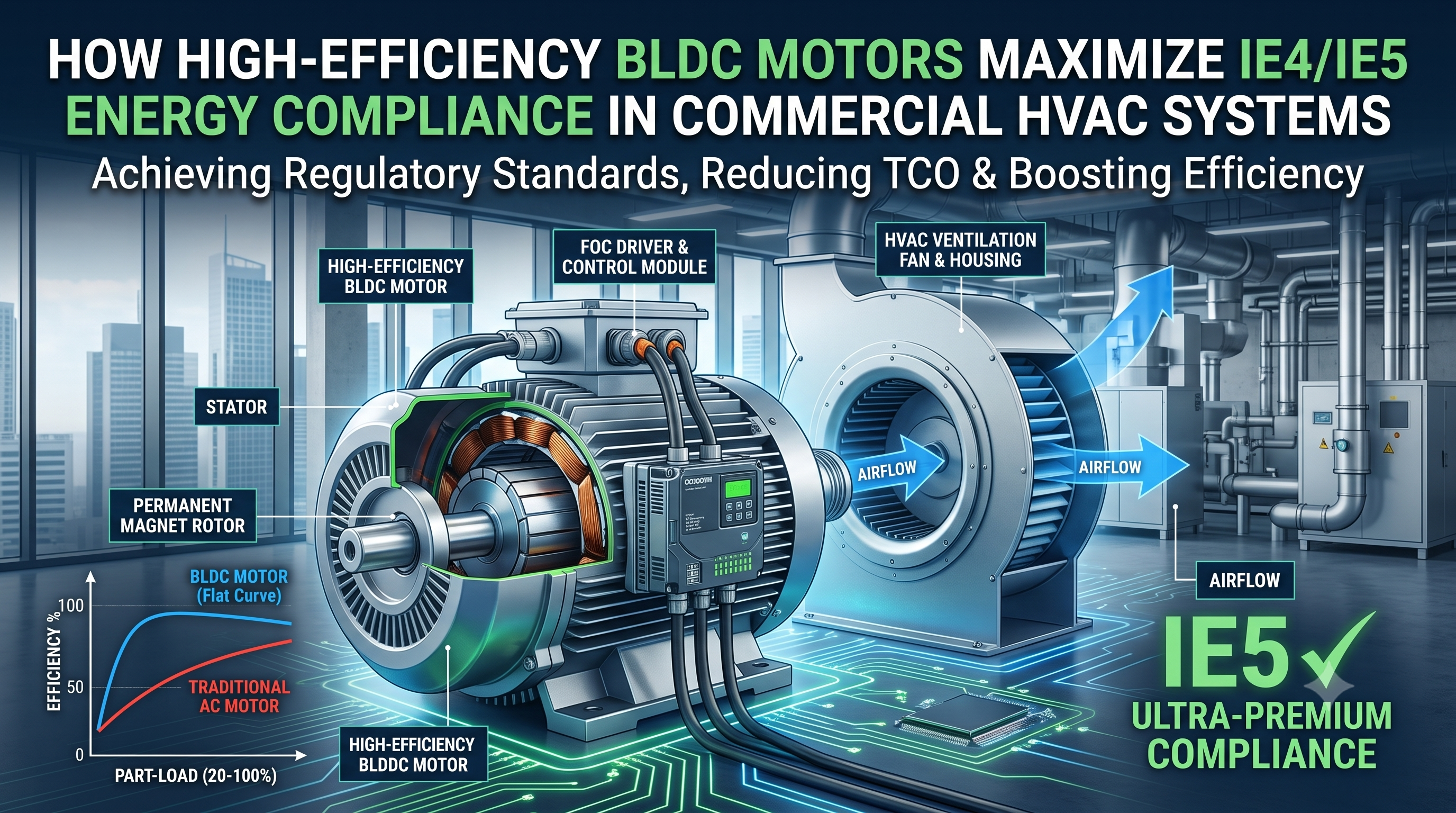
More critically, commercial HVAC systems do not run at continuous full capacity. In fact, systems like commercial ventilation fans or cooling towers operate under part-load conditions (20% to 80% capacity) for more than 80% of their operational lifespan.
When an AC motor slows down via a Variable Frequency Drive (VFD) to meet reduced airflow demands:
* The efficiency curve drops drastically: Motor efficiency decays sharply at lower speeds due to fixed magnetic losses.
* Slip increases: Higher slip leads to increased heat generation within the stator and rotor assemblies.
Conversely, a Brushless DC (BLDC) motor utilizes high-coercivity permanent magnets on the rotor. Because the magnetic field is permanently established, zero energy is wasted on rotor magnetization, eliminating rotor copper losses entirely.
---
2. Quantifying the Compliance Leap: Moving to IE4 and IE5 Standards
The International Electrotechnical Commission (IEC) defines standard efficiency levels from IE1 (Standard) up to IE5 (Ultra-Premium Efficiency). While achieving IE4 with an AC induction motor requires bulky, oversized stator cores and precision copper windings—drastically increasing the motor's physical footprint—a BLDC motor achieves and exceeds IE5 standards with ease.
Broad Efficiency Band
Unlike AC motors that exhibit a narrow "sweet spot" of peak efficiency, BLDC motors maintain a remarkably flat, broad efficiency band. Whether operating at 30% or 100% rated speed, the core efficiency remains consistently high (typically above 90-93%).
Optimized Mechanical Boundary Conditions
By eliminating the bulk iron core needed for induction, BLDC architectures deliver significantly higher power density. For HVAC OEMs, this means achieving higher torque outputs within a much tighter mechanical enclosure. This compact form factor allows design engineers to optimize internal air pathways and reduce the overall dimensions of air handling cabinets.
Decreased Thermal Load
Lower electrical losses translate directly into reduced thermal dissipation. Operating at cooler temperatures extends the life of internal stator insulation and bearing lubricants, directly solving the problem of localized hot spots inside sealed HVAC ducting.
---
3. Financial Impact: Total Cost of Ownership (TCO) and ROI Analysis
Engineering compliance must always align with financial viability. When evaluating component procurement, purchasing managers often over-index on initial acquisition cost rather than Total Cost of Ownership (TCO).
In a typical commercial HVAC application running 24/7, energy consumption accounts for over 90% of the motor's lifetime cost. The initial purchase price represents less than 5%.
| Cost Component | Traditional AC Motor | High-Efficiency BLDC Motor |
| Initial Purchase Cost | Low | Moderate |
| Energy Consumption (Lifetime) | High (Severe degradation at part-load) | Ultra-Low (Flat efficiency curve) |
| Maintenance & Bearing Wear | High (Due to higher operating temperatures) | Low (Cooler running temperatures) |
| System Reliability | Standard | High |
By replacing traditional drives with high-efficiency BLDC systems, commercial operators typically realize 15% to 40% reductions in energy consumption. Consequently, despite a higher upfront component cost, the return on investment (ROI) via utility savings is fully realized within 12 to 24 months, while simultaneously future-proofing the equipment against evolving environmental penalties.
---
4. Factory-Direct Customization: Tailoring BLDC Systems for HVAC OEMs
Transitioning an existing product line from AC to BLDC requires precise engineering integration. As a factory-direct manufacturer, we eliminate the generic, one-size-fits-all approach common with third-party distributors. We work directly with your engineering team to match your specific mechanical and thermal boundaries.
Mechanical and Electrical Integration
We provide custom shaft diameters, specialized mounting flanges, and tailored axial or radial motor configurations designed to bolt directly into your existing fan housings without costly chassis re-tooling.
Advanced Driver and FOC Integration
True HVAC efficiency requires quiet, vibration-free operation. Our BLDC solutions are paired with optimized Field-Oriented Control (FOC) sinusoidal drivers. This precise commutation guarantees minimal electromagnetic interference (EMI) and ultra-quiet acoustic signatures—a paramount requirement for commercial office and hospital environments.
---
Conclusion
Upgrading to high-efficiency BLDC motors is no longer just an optional engineering upgrade; it is the most reliable technical framework for securing IE4 and IE5 energy compliance in commercial HVAC systems. By optimizing part-load efficiency, decreasing thermal load, and significantly reducing lifetime TCO, BLDC technology provides the structural competitive edge that modern HVAC OEMs require.
Optimize Your Drive System Today
Are you ready to transition your commercial ventilation line to meet international IE5 efficiency standards? Contact our technical engineering team today. Provide your specific mechanical dimensions and electrical parameters, and our factory-direct specialists will deliver a comprehensive customized motor integration proposal within 48 hours.