Thermal Derating in 50Nm+ Drives: The Silent Killer of Commercial HVAC Efficiency
Published on July 6, 2026
Let’s skip the marketing fluff and talk about the actual physics of commercial HVAC operations.
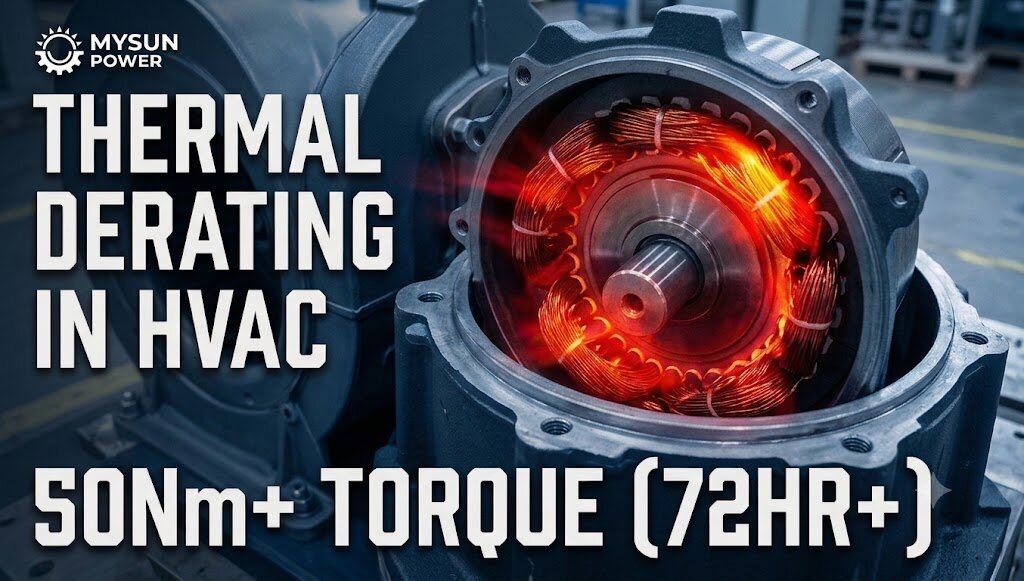
When your procurement team sources a standard BLDC motor rated for 50Nm, they are buying a promise that exists only in a climate-controlled testing lab. In the real world—where commercial HVAC systems run under continuous, heavy loads—that 50Nm spec is a fleeting reality. By hour 72 of uninterrupted operation, thermal derating kicks in. The torque drops, the energy consumption spikes, and the system works harder just to maintain baseline airflow.
This is the hidden "compatibility tax" that OEMs pay when they try to force off-the-shelf outrunners into complex, heavy-duty HVAC architectures.
The Physics We Can't Ignore (And Shouldn't Hide)
Let's be completely transparent: no engineering team on earth can defeat thermodynamics. When a motor generates 50Nm+ of torque continuously, it generates intense heat. That is a hard limitation of electromagnetic efficiency.
The problem isn't the heat itself; the problem is the integration. When you bolt a standard, catalog-bought motor onto a proprietary HVAC fan assembly, the thermal pathways are misaligned. The heat has nowhere efficient to go. The stator coils bake, the magnetic field weakens, and the motor controller inevitably dials back the power to prevent a catastrophic failure.
You bought 50Nm. You are realistically getting 38Nm when you need it most.
The Solution: Parameter-Driven Integration
This is exactly why MYSUN POWER doesn't just sell motors; we engineer Parameter-Driven Powertrain Solutions.
Instead of asking you to adapt your HVAC system to our catalog, we map the exact thermal and load parameters of your specific application before a single piece of copper is wound.
Thermal Pathway Co-Design: We align the motor's heat dissipation characteristics directly with your system's airflow, turning your existing architecture into an active cooling mechanism.
Sustained Electromagnetic Efficiency: By customizing the stator winding and rotor geometry to your exact operational duty cycle, we delay the onset of thermal derating, ensuring that 50Nm on the spec sheet remains 50Nm in the field.
Eradicating the Compatibility Tax
Yes, opting for a parameter-driven, custom-integrated BLDC solution requires a more rigorous initial technical evaluation. It demands more upfront engineering dialogue than simply clicking "buy" on a standard spec sheet.
But for industry leaders, that upfront engineering is an investment, not a cost. By eliminating thermal derating and the subsequent wear on components, you drastically reduce maintenance intervals and protect the system's Total Cost of Ownership (TCO) for the next decade.
It's time to stop paying the compatibility tax.