Engineering for the Abyss: Dynamic Sealing and Pressure Compensation in Deep-Sea ROV Thrusters
Published on July 6, 2026
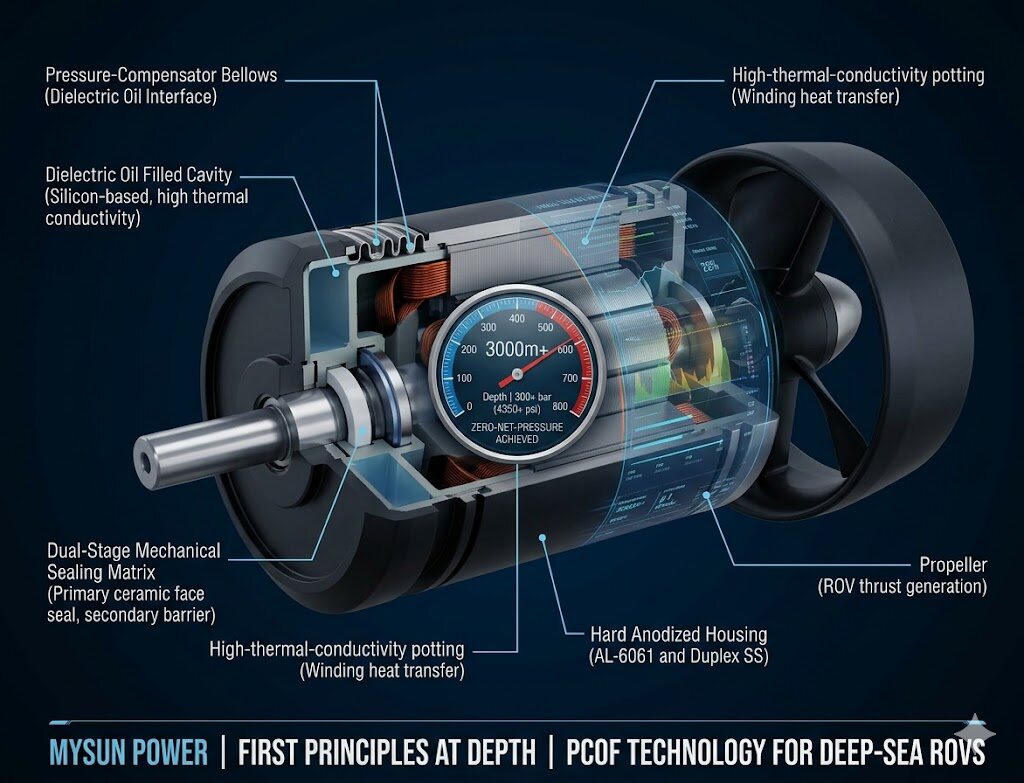
Operating at depths exceeding 3,000 meters presents a brutal reality for BLDC motor integration: a constant hydrostatic pressure of over 300 bar (4,350 psi). In these environments, the conventional "sealed atmospheric housing" approach is a blueprint for catastrophic implosion. At MYSUN POWER, our subsea engineering philosophy rejects the brute-force shielding method in favor of an active, parameter-driven Pressure-Compensated Oil-Filled (PCOF) logic.
The Failure of Static Sealing in Deep-Sea Robotics
Most standard "waterproof" motors rely on static O-rings and simple shaft seals. While effective for shallow-water UAVs or surface vessels, these components fail under the "Compatibility Tax"—the mismatch between internal atmospheric pressure and external hydrostatic crushing force. As the ROV descends, the pressure differential forces seawater through even the most microscopic gaps in the dynamic seal, leading to salt-water ingress, internal short-circuiting, and bearing seizure.
The PCOF Architecture: Achieving Zero-Net-Pressure
To eliminate the risk of implosion and ingress, MYSUN’s deep-sea ROV thrusters utilize a fully flooded internal cavity. The motor housing is vacuum-filled with a high-grade dielectric oil (often synthetic silicon-based or specialized mineral oils).
The core of this system is the Pressure Compensator—a flexible diaphragm or bellows assembly that acts as a physical interface between the internal oil and the external seawater. As the ROV dives and external pressure increases, the compensator compresses, transmitting that exact pressure to the internal oil.
This results in a "Zero-Net-Pressure" environment: the internal pressure perfectly matches the external depth pressure. Because there is no pressure differential, there is no force attempting to "push" seawater into the motor, and the housing can be constructed from lightweight, corrosion-resistant materials without the need for massive, heavy wall thicknesses.
The Challenge of High-RPM Dynamic Sealing
While PCOF handles hydrostatic integrity, the spinning shaft creates a dynamic sealing challenge. A rotating shaft at 3,000 RPM must be sealed against the internal oil to prevent leakage and maintain the compensator's volume.
MYSUN POWER integrates a dual-stage mechanical sealing matrix:
Primary Dynamic Seal: A precision-lapped ceramic or tungsten carbide mechanical seal that manages the boundary between the internal oil and the external environment. Its low-friction coefficient ensures minimal power loss even during long-duration surveys.
Secondary Oil Barrier: A specialized lip seal that provides redundancy, ensuring that even under erratic thermal expansion of the dielectric oil during high-torque operation, the compensator logic remains intact.
Thermal Dissipation in a Flooded Stator
One of the secondary benefits of MYSUN's PCOF approach is superior thermal management. In a standard air-filled motor, heat must travel through air (a poor conductor) to reach the housing. In a MYSUN flooded motor, the dielectric oil acts as a highly efficient thermal conductor, stripping heat directly from the copper windings and transferring it to the aluminum or stainless steel housing, which is continuously cooled by the surrounding sea water.
This allows our ROV thrusters to maintain significantly higher continuous power densities than atmospheric competitors, enabling smaller, more agile ROV designs for extreme exploration.
Conclusion: First Principles at Depth
Designing for the abyss is not about building a stronger box; it’s about aligning with the physics of the environment. By utilizing parameter-driven PCOF logic and advanced dynamic sealing, MYSUN POWER provides the reliability required for the world's most demanding subsea missions.