Demystifying Marine Propulsion: Technical Requirements for Subsea ROV Thruster Motors
Published on July 13, 2026
Demystifying Marine Propulsion: Technical Requirements for Subsea ROV Thruster Motors
The rapid expansion of offshore energy extraction, deep-sea research, and automated marine salvage has placed unprecedented operational demands on Remotely Operated Vehicles (ROVs) and Autonomous Underwater Vehicles (AUVs). At the heart of these subsea robotic platforms lies the marine propulsion system—a critical subsystem where operational success hinges entirely on the reliability of the thruster motor.
For B2B procurement managers and subsea systems engineers, source-selection for underwater motors is uniquely unforgiving. Standard industrial motors fail instantly under maritime environments. Achieving absolute stability at depth requires custom brushless DC (BLDC) motors meticulously engineered for deep-sea deployment.
The Hostile Physics of Deep-Sea Propulsion
Subsea thruster motors operate under a combination of physical stressors rarely encountered in land-based automation. Engineering teams must design specifically against three critical destructive vectors:
Hydrostatic Pressure: As an ROV descends, hydrostatic pressure increases exponentially. Standard motor enclosures will implode or suffer catastrophic seal breach without advanced pressure-compensation mechanics.
Corrosive Electrolytic Environments: Seawater is a highly aggressive electrolyte. Continuous exposure triggers rapid galvanic corrosion of raw metals and degrades standard insulation materials within hours.
High-Inertia Load Shifting: Underwater thrusters must constantly reverse direction and alter velocity to counteract unpredictable marine currents, requiring massive low-speed torque and dynamic responsiveness.
Core Technical Pillars of MYSUN POWER Subsea Motors
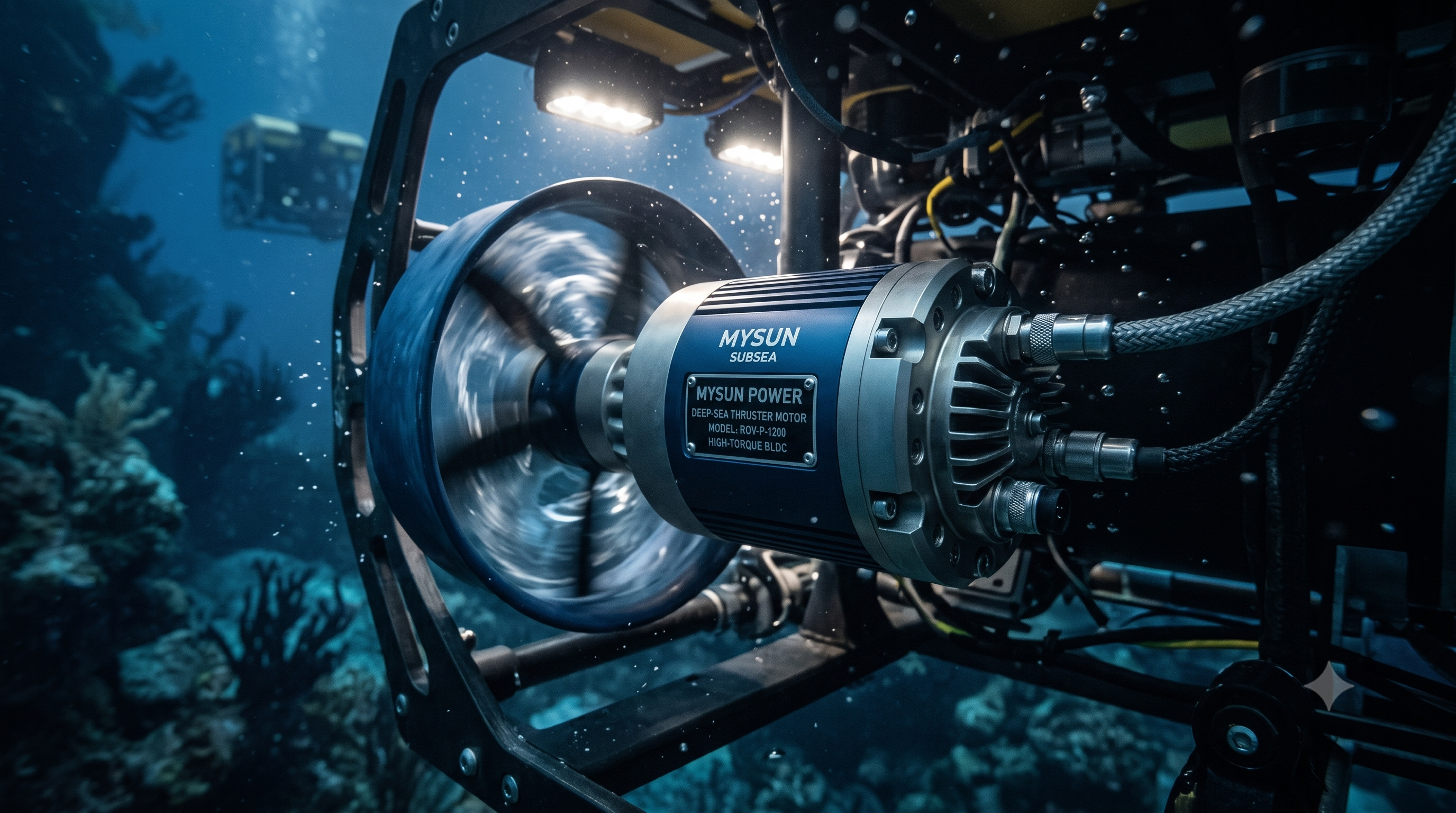
To address the uncompromising realities of ocean engineering, MYSUN POWER develops specialized high-torque brushless DC motors tailored specifically for subsea propulsion units. Our custom designs focus on three core survival methodologies:
Fluid-Filled Pressure Compensation: Rather than fighting hydrostatic pressure with massive, heavy metallic walls, our subsea motors utilize oil-filled, pressure-compensated architectures. By equalizing internal fluid pressure with external ambient ocean pressure, the motor maintains structural integrity at extreme depths while ensuring optimal bearing lubrication.
Advanced Marine-Grade Material Selection: We eliminate galvanic vulnerabilities by utilizing premium titanium alloys, specialized synthetic polymers, and multi-layered chemical encapsulation for all internal stator windings. This guarantees long-term resistance to salt spray and submerged oxidation.
High-Torque Density Performance: Leveraging high-grade permanent magnets and optimized slot-pole configurations, our custom BLDC packages deliver peak torque density. This allows subsea thrusters to maintain exceptional responsive thrust-to-weight ratios, ensuring precise vectoring control for heavy-duty underwater robotic arms and propulsion arrays.
Strategic Engineering Collaboration
Procuring marine propulsion components demands exact alignment between your vehicle's electrical bus, depth rating targets, hydrodynamic drag profiles, and space constraints. Selecting a specialized manufacturing partner capable of executing rigorous pressure-chamber testing and custom shaft profiling is the single most effective way to eliminate deployment failures.
Investing in ruggedized, application-specific subsea drive systems stabilizes project execution schedules, protects costly scientific payloads, and ensures uninterrupted operational uptime in the world's most challenging environments.