The Parameter-Driven Paradigm: Why Standard Motor Specs Are Obsolete in Heavy-Duty Integration
Published on July 6, 2026
In the world of industrial engineering, the most expensive word is "Standard."
For decades, the procurement logic for BLDC motors has followed a predictable, yet flawed, path: open a catalog, find a motor with the right nominal voltage and torque, and "integrate" it. But as heavy-duty systems—from 50Nm HVAC drives to deep-sea ROVs—become more complex, this catalog-first approach is failing.
At MYSUN POWER, we call the resulting failures the "Compatibility Tax." It manifests as unexpected thermal derating, electromagnetic interference, and premature bearing failure. These aren't motor defects; they are integration gaps.
The Standard Spec Sheet Fallacy
A standard motor spec sheet is a snapshot of performance in a vacuum. It doesn't account for the unique thermal impedance of your fan housing, the specific switching frequency of your custom inverter, or the axial loads of a deep-sea propeller.
When you buy "standard," you are buying a component that is jack-of-all-trades but master of none. In high-stakes industrial applications, "average" is a liability.
Defining Parameter-Driven Integration
MYSUN POWER operates on a different paradigm: Parameter-Driven Integration.
Instead of starting with what we have in stock, we start with your system's operational data. We don't just ask for torque and RPM; we map the entire ecosystem:
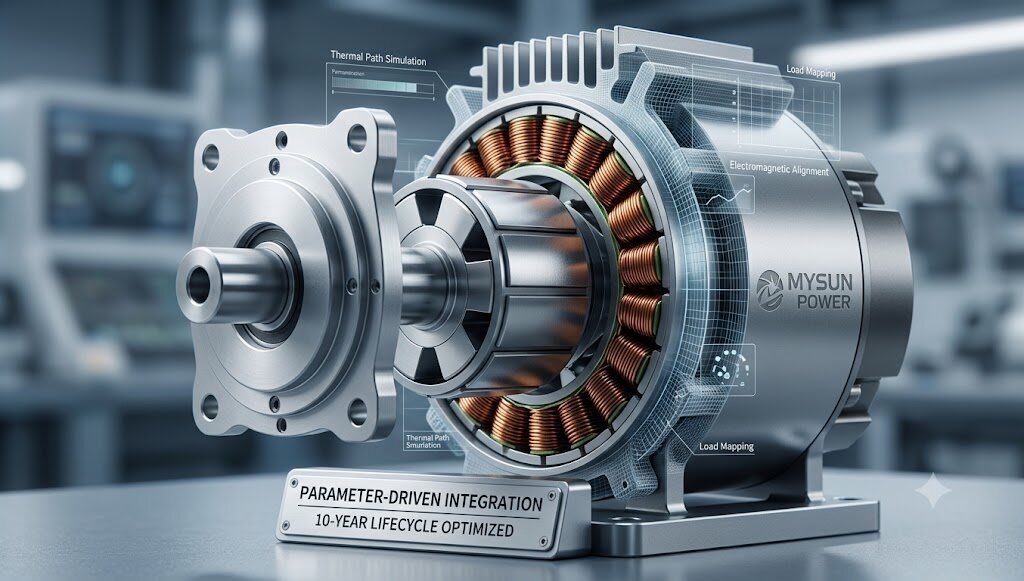
Electromagnetic Alignment: We customize winding patterns to match your controller’s specific PWM frequency, reducing harmonic losses and audible noise.
Thermal Path Co-Design: We treat the motor and your housing as a single thermal unit, optimizing heat dissipation pathways to delay derating in continuous 50Nm+ operations.
Mechanical Synergy: From non-standard flange geometries to specific bearing grades for deep-sea pressure, every mechanical interface is optimized to eliminate the need for "adapters" or "patches."
The "Sincere Weakness": The 30-Day Alignment
We will be honest: a Parameter-Driven approach takes more time upfront. While a standard motor can be shipped in 48 hours, our alignment phase typically requires 30 days of intensive engineering dialogue.
We don't "click and ship." We validate.
However, this initial 30-day investment is what eradicates the Compatibility Tax. It ensures that when your system hits the field, it stays there. No mid-season recalls, no emergency maintenance, and a Total Cost of Ownership (TCO) that is 40% lower over a 10-year lifecycle.
Conclusion: Move Beyond the Catalog
If your project requires high-torque reliability beneath the waves or in critical infrastructure, you cannot afford the risks of "standard." You need a partner that speaks the language of parameters, not part numbers.