Engineering for Extremes: Reliable Propulsion Solutions for Deep-Sea ROVs
Published on July 6, 2026
Operating a Remotely Operated Vehicle (ROV) at depths exceeding 3,000 meters requires propulsion systems that transcend standard engineering limits.
In the abyss, hydrostatic pressure and aggressive saline corrosion are unforgiving constants. For marine engineers and ROV developers, selecting an "off-the-shelf" motor is a massive operational risk.
True subsea reliability demands parameter-driven Brushless DC (BLDC) motor integration, where every component is engineered to survive and perform in the planet's most extreme environments.
Conquering Hydrostatic Pressure
At full ocean depth, equipment faces crushing hydrostatic pressure. Standard sealed motors simply cannot withstand these forces, making their dynamic shaft seals the number one point of subsea failure.
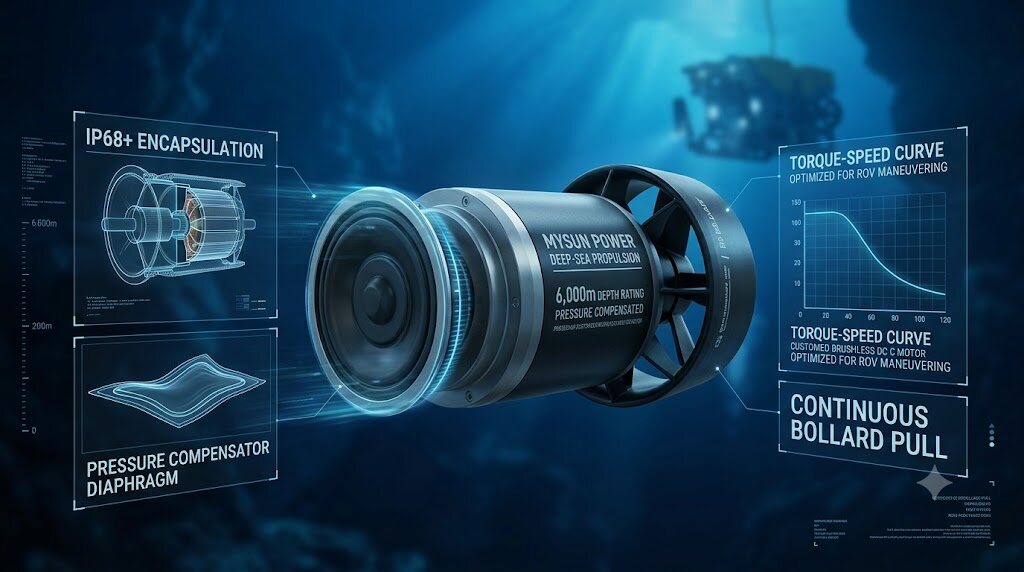
To counteract this, advanced ROV propulsion systems rely on Pressure Compensation Technology. Instead of utilizing thick, heavy metallic walls to fight the pressure, the motor enclosures are oil-filled. A flexible compensator allows the internal fluid volume to balance precisely with the external hydrostatic pressure. This creates a "pressure-neutral" state, ensuring that the precision BLDC stators and rotors operate flawlessly without the risk of implosion or seal rupture, regardless of the operating depth.
Defeating Saline Corrosion with Advanced Materials
Seawater acts as a powerful electrolyte, accelerating galvanic corrosion that can destroy standard motor housings in a matter of weeks. Reliable ROV propulsion requires a multi-layered defense strategy:
IP68+ Encapsulation: The internal electromagnetic components (stator windings) undergo rigorous vacuum potting and encapsulation processes, completely isolating them from any potential moisture ingress.
Specialized Anti-Corrosion Treatments: Outer housings are constructed from aerospace-grade aluminum alloys treated with military-spec hard anodizing, or specialized marine-grade materials like Grade 5 Titanium, depending on the project's specific lifespan and budget requirements.
Magnetic Coupling (Where Applicable): By utilizing advanced magnetic coupling to transmit torque from the motor to the propeller, we can completely eliminate the need for dynamic physical shafts passing through the hull, thereby entirely removing the risk of water ingress at the shaft axis.
Optimizing Hydrodynamic Efficiency and Thrust
In deep-sea intervention tasks, maneuvering massive ROVs against strong ocean currents requires instant torque and sustained power. Our parameter-driven integration focuses heavily on optimizing the Continuous Bollard Pull.
Instead of forcing a standard motor to handle heavy loads, we custom-calibrate the motor's voltage constants (KV ratings) and torque-speed curves to match the specific hydrodynamic profile of your ROV's propellers. This precise electromagnetic matching ensures that the thrusters deliver maximum forward and lateral thrust while maintaining strict thermal management and extending the battery life of the submersible.
Conclusion
When designing for the deep sea, there is zero margin for error. A failure at 6,000 meters means aborted missions and massive financial losses. By partnering with a custom BLDC motor integrator, marine engineers can secure propulsion solutions built on rigorous pressure testing, uncompromised material science, and exact application matching. It is not just about supplying a motor; it is about engineering absolute certainty for the abyss.