The Technical Buyer’s Guide: Reducing Total Cost of Ownership (TCO) in Industrial BLDC Motor Procure
Published on July 8, 2026
Introduction
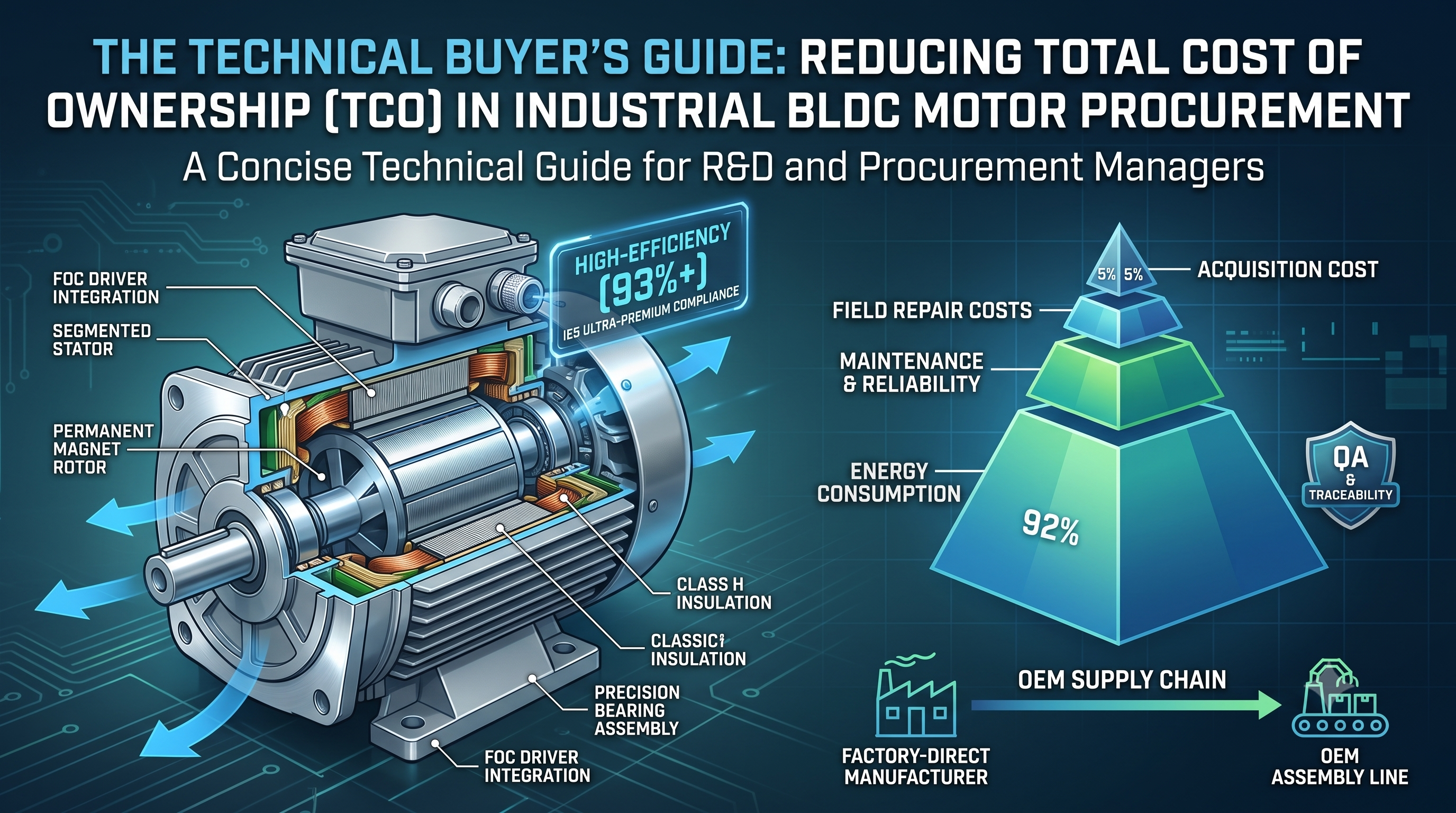
In industrial motion control, the sticker price of a Brushless DC (BLDC) motor is only the visible tip of the financial iceberg. True procurement efficiency is measured by Total Cost of Ownership (TCO). Opting for low-cost, unverified solutions introduces severe downstream risks: premature field failures, unexpected maintenance overhead, and catastrophic operational downtime. For equipment operating on continuous 24/7 duty cycles, energy consumption and reliability risks represent over 90% of the motor's lifetime cost. Selecting the right architecture upfront is a critical risk-mitigation strategy.
Hidden Risks in Cheap BLDC Motor Components: When suppliers offer unsustainably low prices, cost reductions are invariably achieved by compromising internal material tolerances.
First, cheap motors use low-grade Neodymium magnets that suffer from irreversible thermal demagnetization under prolonged load, leading to a permanent drop in torque output.
Second, substituting precision-matched, double-shielded bearings with low-grade components leads to axial play, increased acoustic noise, and premature mechanical seizing.
Third, poor stator varnishing increases the risk of internal short circuits under high-frequency PWM drive signals, causing sudden electrical failure.
Strategic Advantage of Factory-Direct Sourcing: Sourcing through trading companies or multi-tier distributors adds unnecessary margins and dilutes technical accountability. Partnering directly with a factory-direct manufacturer structurally optimizes the OEM supply chain.
It eliminates middleman markups to ensure volume-based cost efficiency. It gives your team direct communication with R&D designers rather than scripted customer service. It allows full flexibility for custom shaft, winding, and electrical integration instead of forcing you to use standard catalog sizes. Finally, it ensures full raw material traceability and strict QA rather than fragmented batch monitoring.
When an OEM design engineer needs to modify a mechanical boundary, alter a winding profile, or request a custom mounting flange, a direct factory partnership eliminates communication bottlenecks, delivering exact prototype revisions without translational errors.
The Technical Buyer's Pre-Procurement Checklist: Before signing a high-volume supply agreement, engineering and procurement teams should jointly audit suppliers against this technical baseline:
Magnetic Stabilization: Are permanent magnets rated for the application's maximum thermal boundaries without demagnetization risk?
Insulation Grade: Does the stator winding utilize Class F (155°C) or Class H (180°C) materials to handle harsh industrial duty cycles?
Mechanical Tolerances: What is the certified runout tolerance on the output shaft? Are bearing seats precision-ground?
Driver Interoperability: Has the motor design been validated with Field-Oriented Control (FOC) sinusoidal drivers to ensure low EMI and smooth torque delivery?
Conclusion: Industrial procurement optimization is about long-term risk mitigation. By prioritizing high-grade internal component architectures and moving to a direct factory partnership, OEMs eliminate middleman markups, safeguard brand reputation, and secure the lowest true TCO.
Ready to optimize your motion control supply chain? Contact our factory-direct specialists today with your specific mechanical dimensions and electrical parameters for a direct volume quotation within 48 hours.