Engineering for Extremes: UAV & Deep-Sea Propulsion Systems
Published on July 6, 2026
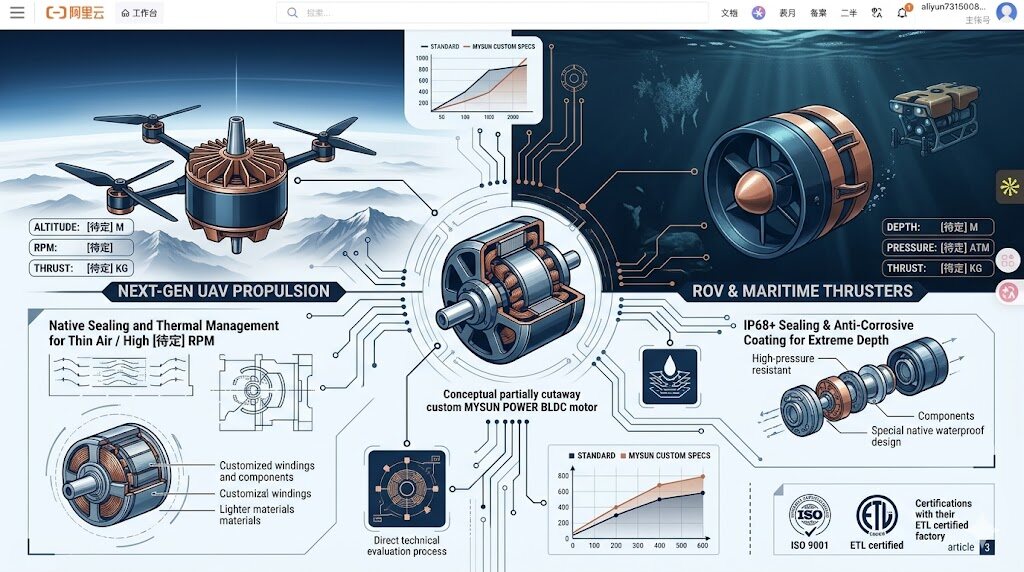
Standard industrial motors are designed for predictable, ambient environments. However, systems deployed in UAVs (Unmanned Aerial Vehicles) or Deep-Sea ROVs (Remotely Operated Vehicles) face entirely different physical realities. Overcoming these extremes requires fundamental shifts in motor architecture rather than superficial modifications.
For subsea applications, relying solely on external O-rings for water resistance is a temporary fix in high-pressure, corrosive salt-fog environments. True subsea reliability requires native IP68 or IP69K waterproof designs. This involves specialized potting compounds that encapsulate the stators and custom anti-corrosive surface treatments that permanently withstand deep-water pressure without degrading.
Conversely, UAV propulsion systems face the challenge of thermal management in thin, high-altitude air where standard convective cooling fails. Optimization here focuses on aggressive weight reduction and utilizing advanced heat-dissipating alloys to maintain a high thrust-to-weight ratio. By engineering these environmental defenses directly into the motor's core structure, manufacturers can guarantee sustained operational integrity where standard components would immediately fail.