Thermal Boundaries and Mechanical Integration: Optimizing Brushless Motors for UAV and ROV Micro-Pro
Published on July 8, 2026
Introduction
Modern unmanned aerial vehicles (UAVs) and remotely operated vehicles (ROVs) demand micro-propulsion systems that push the absolute limits of power density and environmental resilience. For OEM design engineers, selecting a brushless DC (BLDC) motor is no longer just about matching voltage and RPM.
Instead, the core engineering bottlenecks lie within mechanical integration boundaries and thermal management limitations. Whether a vehicle is operating in thin atmospheric conditions at high altitudes or enduring extreme hydrostatic pressure deep underwater, the motor's architectural adaptation directly dictates system reliability.
---
1. The Power-to-Weight Dilemma in Micro-Propulsion
In both aerial and submersible robotics, every gram of dead weight exponentially increases power consumption and reduces mission run-time. Achieving an optimal power-to-weight ratio requires maximizing the magnetic flux density within the smallest possible physical footprint.
Stator and Rotor Optimization
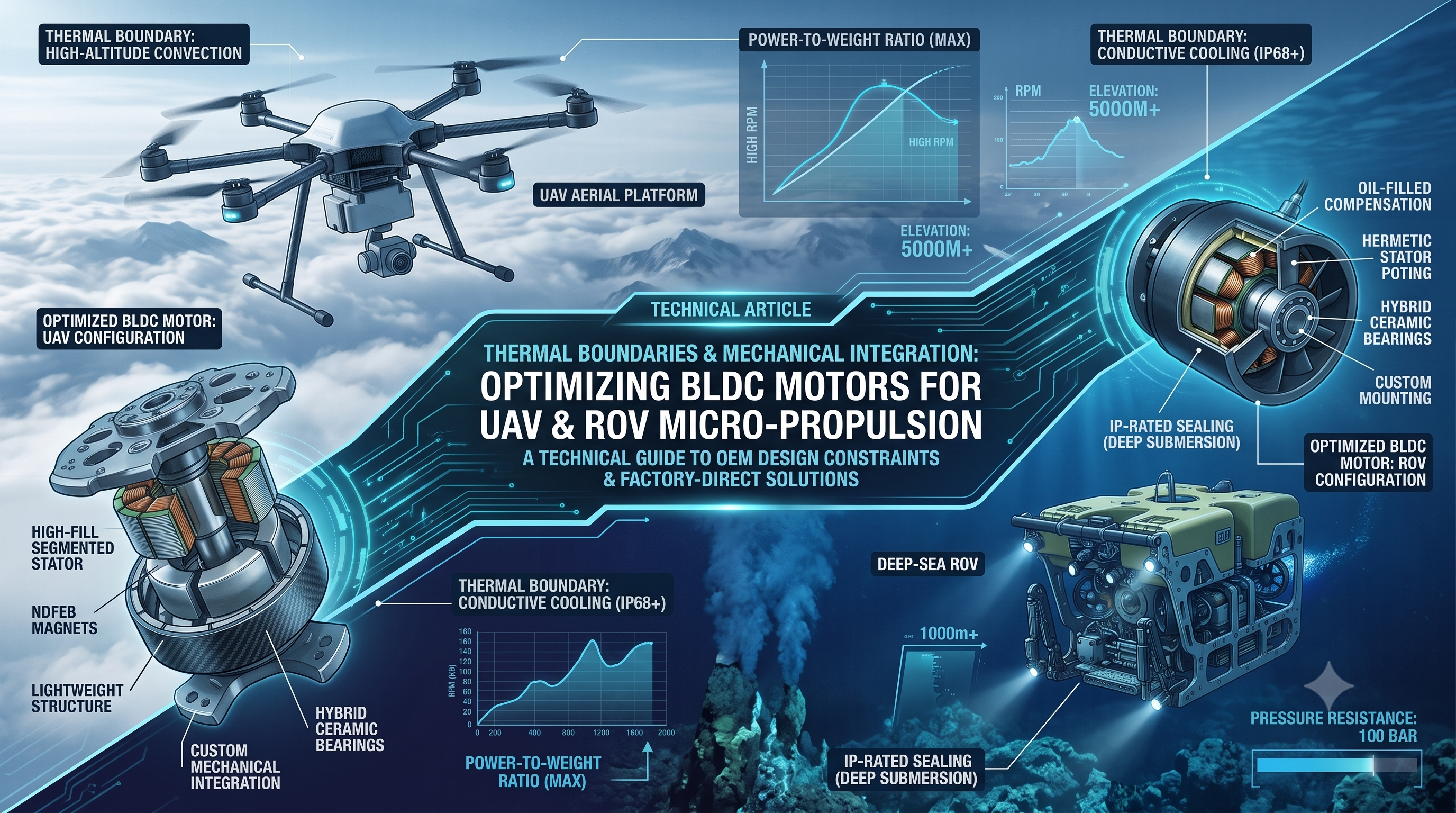
To achieve high torque density without increasing mass, high-performance BLDC motors utilize segmented stator cores wrapped with high-fill-factor copper windings. Combined with ultra-high-energy permanent magnets (such as NdFeB grade magnets), this design ensures maximum electromagnetic torque generation per cubic millimeter.
Structural Lightweighting
Utilizing aircraft-grade CNC-machined aluminum (e.g., 7075-T6) or carbon fiber composite integration for the motor housing reduces structural weight while maintaining rigid mechanical tolerances. This structural rigidity prevents housing deflection under high centrifugal forces or sudden payload shifts.
---
2. Navigating Thermal Boundaries in Confined Spaces
Thermal dissipation is the primary limiting factor for continuous peak power output. When a BLDC motor operates in a tightly sealed electronics bay or an enclosed propulsion pod, heat accumulation can rapidly lead to stator insulation breakdown or permanent magnetic demagnetization.
High-Altitude UAV Challenges
In low-density high-altitude environments, convective cooling becomes highly inefficient. Heat must be dissipated primarily through conductive pathways via the motor mount or specialized radiative surface geometries. Without precise thermal boundary modeling, continuous high-current draws during ascent can trigger localized thermal runaway.
Deep-Sea ROV Hydrostatic Boundaries
For ROVs, while the surrounding water provides an excellent heat sink, the motor must be completely protected from ingress and pressure. Design pathways generally fall into two categories:
* Fully Enclosed Oil-Filled Systems: The motor internal cavity is filled with pressure-compensated dielectric fluid. This design provides both hydraulic pressure balancing and efficient fluid-medium thermal conduction from the stator to the external environment.
* Hermetic Encapsulation: Stator assemblies are vacuum-potted with high-thermal-conductivity epoxy resins to withstand continuous submersion while isolating electrical components from seawater corrosion.
---
3. Mechanical Integration and Environmental Isolation
Operating at the intersection of air, water, and mechanical friction requires robust sealing and bearing architectures tailored to specific operational mediums.