Eradicating the "Compatibility Tax" in Commercial HVAC Multi-Phase Motor Integration
Published on July 6, 2026
In commercial HVAC infrastructure, procurement decisions are heavily weighed down by a single, flawed metric: initial acquisition cost. When retrofitting a building's air handling units (AHUs) or designing next-generation variable refrigerant flow (VRF) systems, selecting a generic, catalog-standard brushless motor seems like the low-risk financial path.
In reality, this compromise introduces what we at MYSUN POWER call the "Compatibility Tax"—the continuous, compounding drain on system efficiency, maintenance headroom, and structural layout caused by integrating a power system that was engineered for general use rather than your specific thermodynamic parameters.
The Hidden Anatomy of the Compatibility Tax
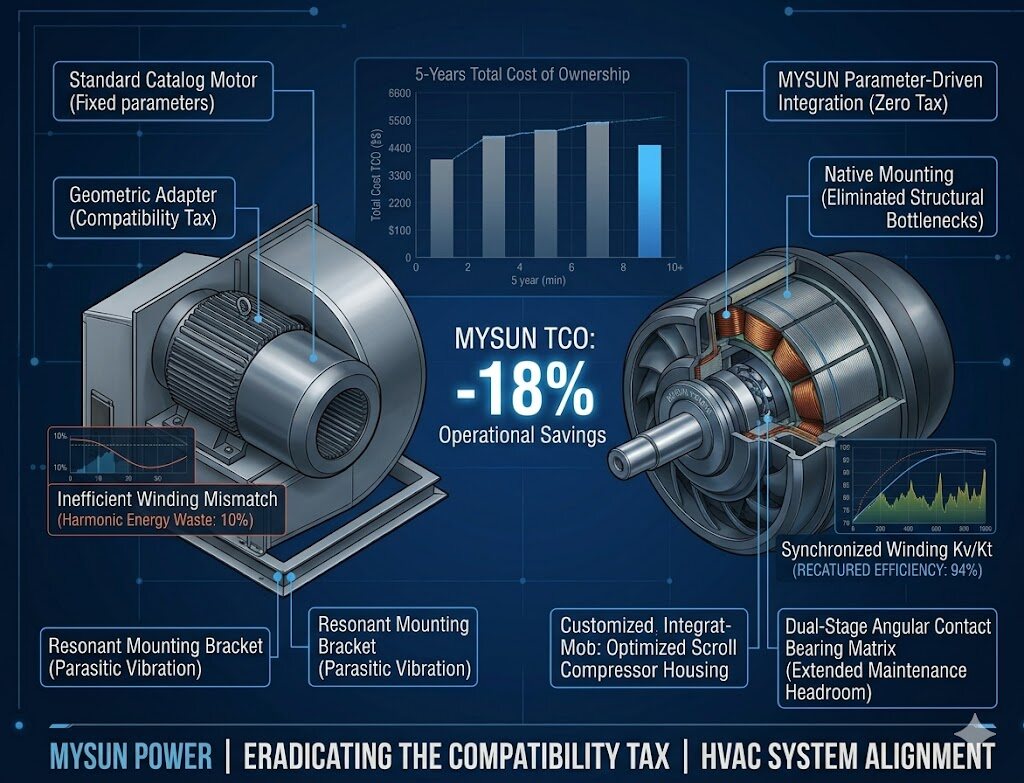
When a standard catalog BLDC motor is forced into a high-demand commercial HVAC system, the engineering team must design around the motor’s fixed constraints. This inverse logic manifests in three critical bottlenecks:
Impedance Mismatch and VFD Inefficiency: Standard motors have fixed winding configurations. When paired with a premium Variable Frequency Drive (VFD), the switching frequencies rarely align perfectly. This impedance mismatch causes harmonic distortion, forcing the VFD to work harder and wasting up to 8% to 12% of input energy as parasitic heat.
Structural Over-Engineering: To accommodate a standard motor’s frame size and shaft alignment, structural engineers are forced to design custom mounting brackets, adapters, and coupling mechanisms. You are spending engineering hours to fix a geometric problem that shouldn't exist.
Accelerated Bearing Wear: HVAC fans and compressors place specific axial and radial loads on the motor shaft. Catalog motors utilize general-purpose bearings that are not rated for the asymmetric cyclic stress of variable-speed commercial blowers, leading to early mechanical fatigue and unpredictable maintenance cycles.
The MYSUN Paradigm: Parameter-Driven Alignment
MYSUN POWER eliminates the compatibility tax by treating the motor not as an isolated component, but as an integrated extension of the HVAC system’s fluid dynamics. Our engineering process aligns the motor with your operational reality through clear-sheet parameters:
Synchronized Winding Constants (Kv/Kt): We customize the stator windings to match the exact voltage and current curves of your specific inverter drive at peak load. By eliminating the harmonic friction, system efficiency immediately jumps into the 93% to 95% range.
Application-Specific Bearing Matrix: Instead of off-the-shelf solutions, our HVAC line incorporates heavy-duty, double-shielded angular contact bearings or ceramic hybrids tailored to withstand continuous variable-speed axial thrust without lubricant breakdown.
Form-Factor Integration: We modify the mounting flanges and housing geometries at the manufacturing stage. The motor drops directly into your fan cage or scroll compressor housing with zero adapters required.
The Hard Math of True TCO
Let’s look past the purchase order. A catalog HVAC motor might save $50 upfront compared to a MYSUN custom solution. However, over a 5-year operational lifecycle in a commercial facility, that catalog motor’s 10% efficiency deficit and higher failure rate translate directly to inflated energy bills and premature system downtime.
When scaled across an entire building or a fleet of manufactured HVAC units, the "Compatibility Tax" quickly becomes the single largest operational leak in your budget.
Conclusion: Force the Power to Match the Purpose
True supply chain and engineering resilience is achieved when you refuse to accept "close enough." By shifting to MYSUN’s parameter-driven BLDC integration, commercial HVAC manufacturers and building operators stop paying the price for standard limitations and start engineering for true return on investment.