Beyond Standard Specs: Why a Parameter-Driven Approach is Essential for Custom Motor Manufacturing
Published on July 6, 2026
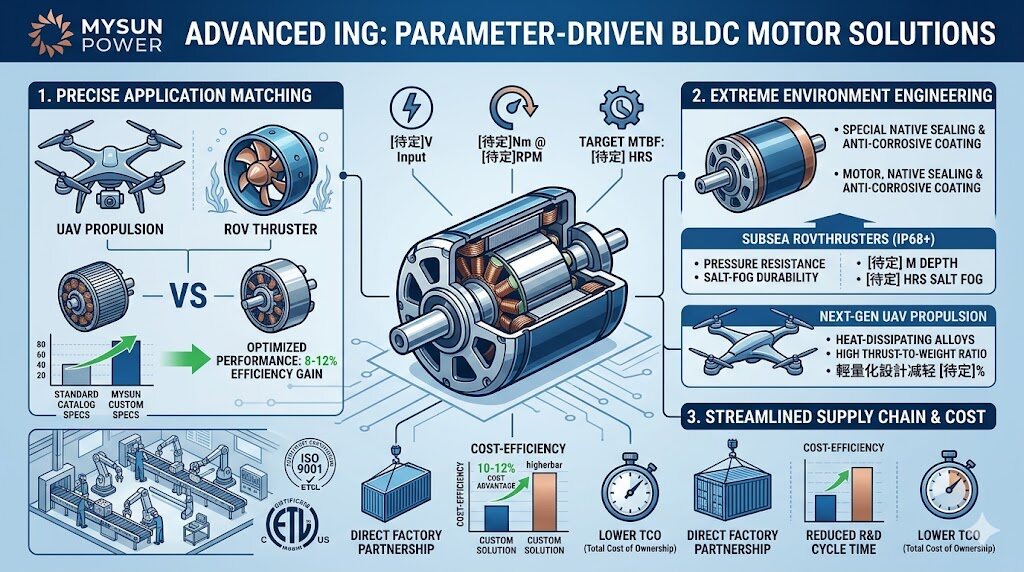
In the development of complex industrial machinery, forcing a standard catalog motor into a highly specialized system is a common engineering compromise. This often leads to either costly power redundancies or premature equipment failure. To solve this, leading equipment developers are shifting toward a parameter-driven procurement model.
Rather than selecting from pre-existing lists, this model requires clients to define exact technical boundaries upfront—such as precise voltage input ranges, target RPM at specific torque loads, and MTBF (Mean Time Between Failures) goals. By transmitting these exact parameters directly to the manufacturing facility, the engineering team can customize the stator windings, rotor dynamics, and housing dimensions to perfectly match the application.
This direct-to-factory data exchange eliminates the guesswork typically associated with standard components. It drastically reduces the number of prototype iterations required, shortens the overall R&D cycle, and ensures the final propulsion system integrates seamlessly into the end product. For specialized applications, evaluating custom parameters is the most efficient first step in the engineering process.