
Optimizing Thrust-to-Weight Ratio: How to Choose BLDC Motors for Heavy-Payload UAVs
Published on July 21, 2026
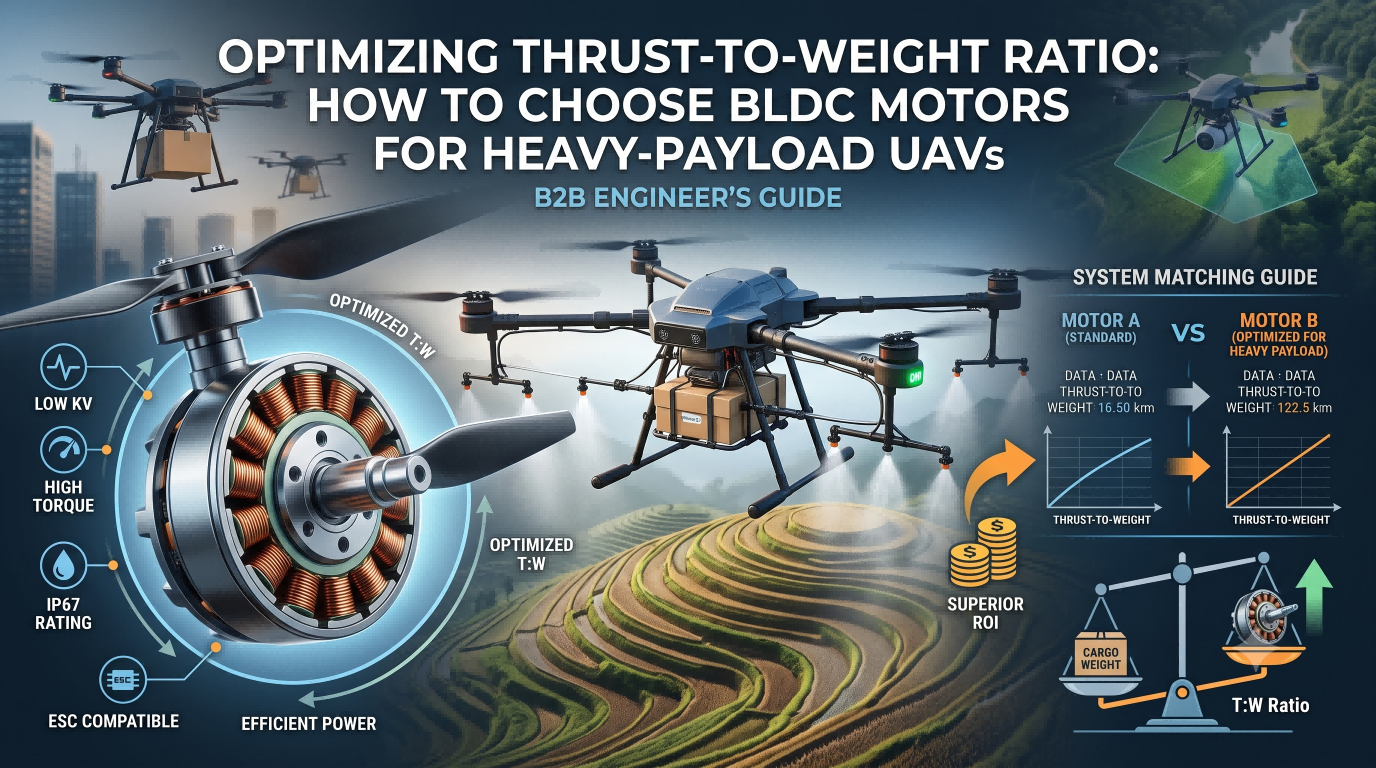
Heavy-payload commercial UAVs used in agricultural spraying, environmental mapping, and logistics delivery require dependable propulsion systems. Selecting the right Brushless DC (BLDC) motor directly determines flight stability, maximum payload capacity, and battery endurance.
Key Factors in BLDC Motor Selection
1. Thrust-to-Weight Ratio
Commercial drones require a proper thrust-to-weight ratio to maintain maneuverability under full load. A target ratio between 2:1 and 2.5:1 provides enough margin for attitude control, altitude changes, and wind resistance during operation.
2. KV Rating and Propeller Matching
Heavy-payload drones rely on high torque at lower rotation speeds to drive large propellers efficiently. Low KV motors paired with large-diameter carbon fiber propellers maximize aerodynamic efficiency and keep operational temperatures low.
3. ESC Compatibility and Response Time
The Electronic Speed Controller (ESC) must match the continuous and peak current capacity of the motor. Fast response times in the ESC allow precise throttle adjustments, ensuring flight stabilization under dynamic load conditions.
4. Thermal Management and Protection
Industrial UAVs frequently operate in dusty, hot, or high-humidity environments. Motors with sealed IP67 protection prevent dust and moisture ingress while maintaining sufficient passive cooling.
Conclusion
Selecting the correct combination of motor KV, propeller size, and ESC rating helps engineers optimize power efficiency, extend flight times, and improve drone reliability.