Custom Winding Specs for BLDC Motors: How KV and Torque Constant (Kt) Impact System Efficiency
Published on July 29, 2026
When designing custom Brushless DC (BLDC) motors for OEM industrial equipment, selecting the correct stator winding configuration is critical. Winding design directly determines motor RPM per volt, current draw, internal resistance, and overall thermal efficiency.
Engineers must balance two fundamental electromotive parameters: the Velocity Constant (KV) and the Torque Constant (Kt).
Understanding KV and Torque Constant (Kt)
1. Velocity Constant (KV)
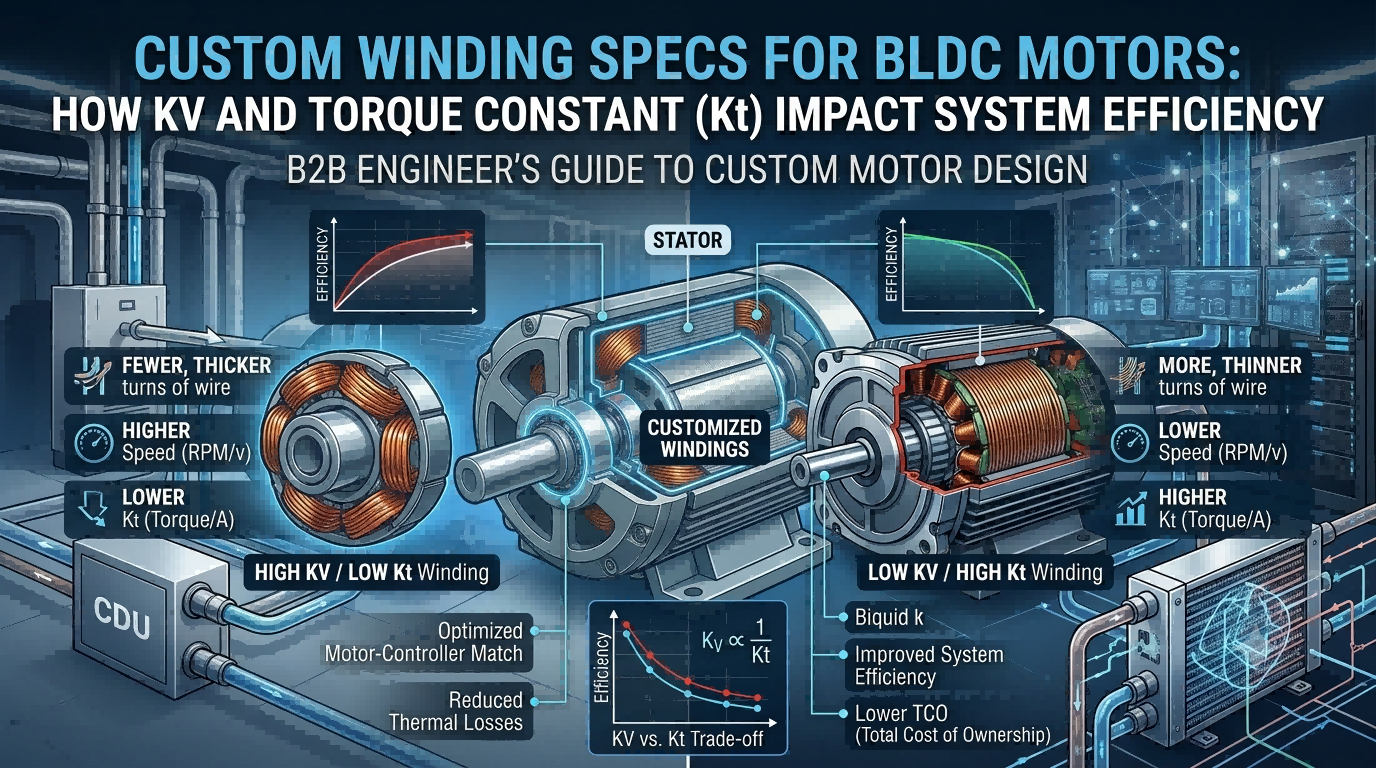
KV represents the motor shaft rotation speed (RPM) generated per applied volt of direct current under no-load conditions. High KV windings use fewer turns of thicker copper wire, producing higher top speeds at lower supply voltages.
2. Torque Constant (Kt)
Kt defines the amount of rotational torque generated per ampere of motor current. KV and Kt are inversely proportional. A motor with a lower KV rating possesses a higher Kt value, producing greater torque per amp.
Impact on System Voltage and Thermal Efficiency
Matching Winding Specs to Power Supply
Choosing a low KV winding allows system engineers to operate at higher DC bus voltages (such as 48V or 72V rather than 24V) while maintaining target operating speeds. Higher operating voltages reduce current draw for the same power output.
Reducing Copper Losses
Lower current levels dramatically reduce resistive copper losses (heat generation) in motor windings and interconnect wiring. This improves overall thermal stability during continuous 24/7 duty cycles.
Matching Winding Parameters with Controllers
1. Controller Current Limits
High KV motors draw larger peak currents during acceleration. The Electronic Speed Controller (ESC) or driver must be rated to handle these high current spikes without thermal shutdown.
2. Back-EMF Considerations
Low KV windings generate higher Back-Electromotive Force (Back-EMF) at elevated speeds. The controller must support adequate input voltage headroom to maintain speed regulation under full load.
Summary
Customizing BLDC motor winding turns, wire gauge, and phase connections enables OEMs to optimize system efficiency, reduce controller heat, and meet precise torque-speed requirements.