Motor Selection Considerations for Dairy Automation and Wash-Down Environments
Published on July 18, 2026
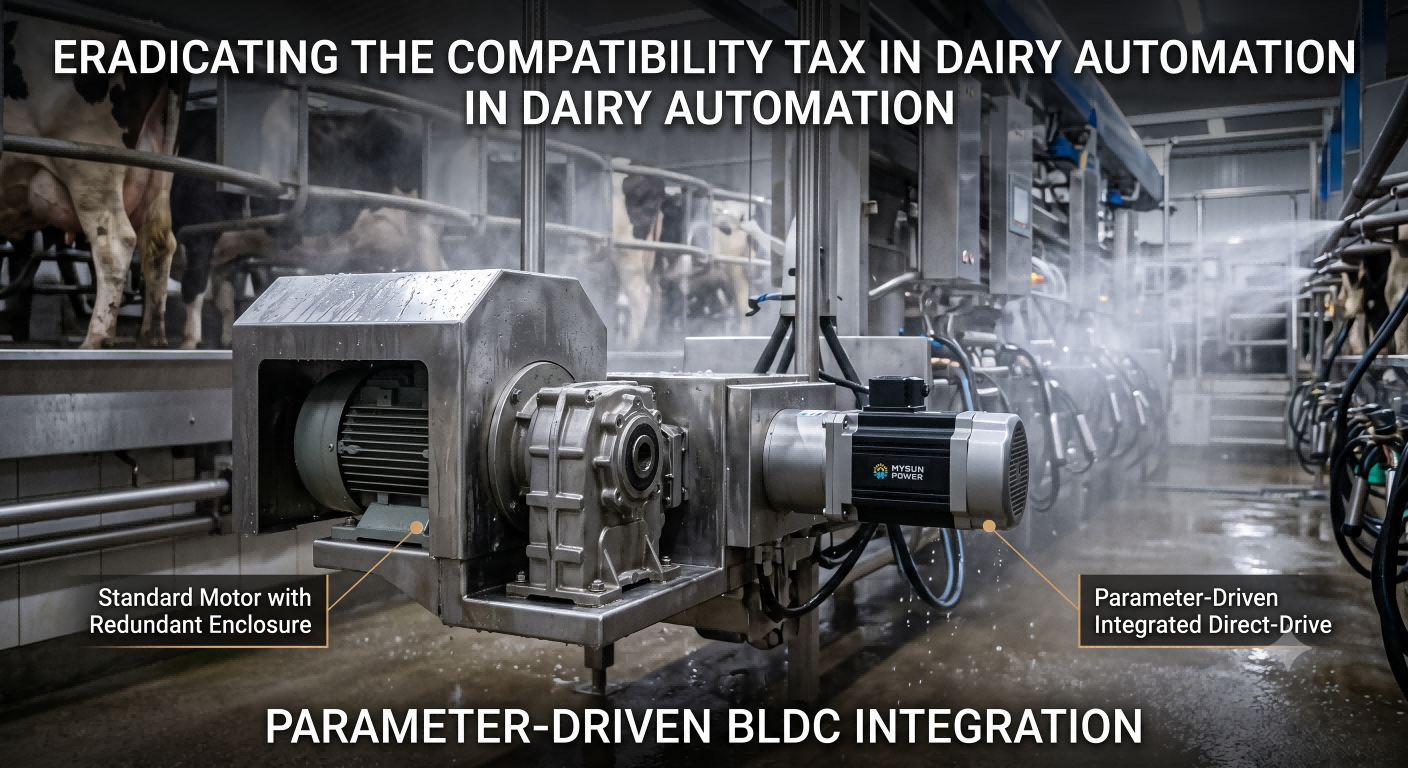
Automated milking systems and livestock farming robotics operate in some of the most unforgiving industrial conditions on the planet. High humidity, heavy high-pressure wash-downs, and corrosive ammonia environments are standard. Yet, many strategic procurement teams unconsciously compromise their equipment's reliability by sourcing rigid, off-the-shelf catalog motors.
Because standard motors are not designed to survive the barn environment natively, engineering teams must build expensive defensive layers around them. This adds cost, complexity and additional failure points to the system.
Common Adaptation Measures in Agricultural Automation To protect a standard catalog motor in a dairy facility, OEMs often resort to workarounds, including:
Designing and machining custom stainless steel secondary enclosures.
Adding specialized external gearboxes to compensate for standard motors lacking native low-speed torque.
Integrating complex secondary rotary seals that are highly susceptible to chemical degradation and moisture ingress over time.
Each additional protective layer can increase BOM (Bill of Materials) cost, add supply chain complexity, and introduce potential failure points.
Parameter-Driven BLDC Approach MYSUN POWER applies a Parameter-Driven BLDC Integration approach focused on demanding agricultural operating conditions.
Rather than relying solely on external protective measures, the motor design itself can be tailored to the application. By considering stator configuration, KV rating, and corrosion-resistant materials in the design, motors for such applications should be evaluated for suitability in wash-down environments, with appropriate sealing and material selection based on the specific operating conditions.
Structurally Reducing Unit-Level TCO Integrating a parameter-driven BLDC motor into milking or feeding robotics may offer the following considerations:
System Integration Review: Evaluate whether secondary enclosures, transmission components or additional sealing measures are required for the actual operating environment.
Supply Chain Simplification: Reducing the number of separate component vendors may simplify procurement and logistics.
Total Cost of Ownership (TCO) Considerations: A motor designed with appropriate sealing and corrosion resistance for the operating environment may help reduce moisture-related maintenance over its service life.
Planning a motor application for humid or wash-down operating conditions? Share the required voltage, torque, speed, installation dimensions, duty cycle and environmental requirements. The engineering team will review the information and confirm the available assessment scope and response schedule.