Demystifying Commercial HVAC Efficiency: Why Parameter-Driven BLDC Integration Beats Off-the-Shelf S
Published on July 6, 2026
In the era of smart buildings and high-density data centers, the demand for HVAC (Heating, Ventilation, and Air Conditioning) efficiency has moved from a secondary operational concern to a primary strategic priority. As commercial facilities strive for higher SEER/APF ratings and lower PUE (Power Usage Effectiveness), the powertrain within the airflow system—the BLDC motor—is under the spotlight.
However, a fundamental engineering gap persists. Many system designers still rely on Standard Product Catalogs. In complex commercial environments, this "convenience" comes with a steep price: the Compatibility Tax.
---
The Variable Load Challenge in Commercial HVAC
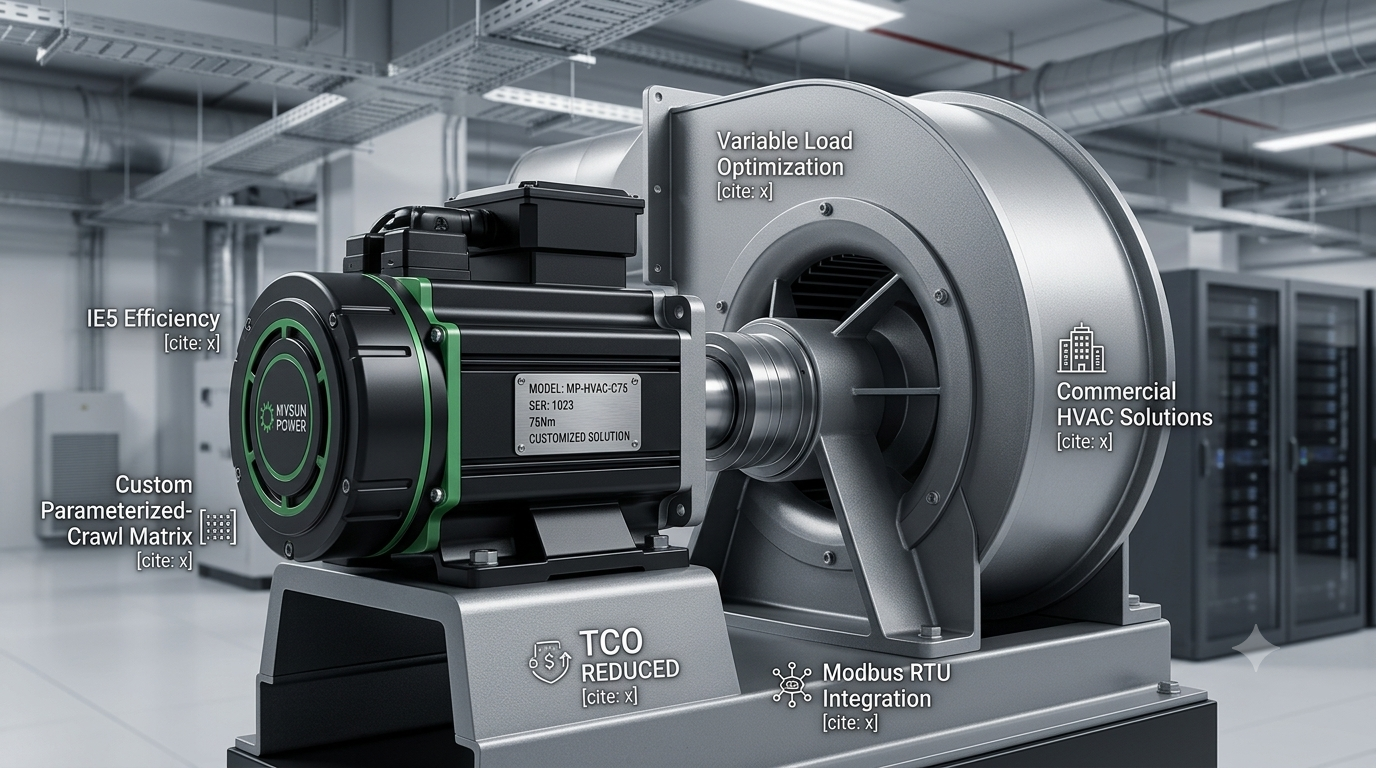
Unlike industrial fans that often run at constant speeds, commercial HVAC systems (such as VAV units, VRF systems, and precision cooling for data centers) operate under highly dynamic conditions. A typical commercial motor rarely runs at 100% load; instead, it spends 70% of its life operating at 30-50% capacity.
This is where catalog motors fail. Most off-the-shelf BLDC motors are optimized for a single, full-load peak efficiency point. When the system dials down during low-occupancy hours or reduced server activity, the catalog motor’s efficiency curve drops sharply. The result? Massive cumulative energy waste that standard specifications never account for.
---
Data Centers: The High-Stakes Frontier
For data center operators, energy waste isn't just a cost—it’s lost capacity. Cooling typically accounts for 33% to 40% of a data center's total energy budget.
When a standard motor is used in a CRAC (Computer Room Air Conditioning) unit, its inability to perfectly align with the controller’s switching frequency or the fan’s specific aerodynamic resistance leads to electromagnetic losses and harmonic distortion. By shifting to a Parameter-Driven Integration, operators can achieve a "flat efficiency curve," maintaining IE4 or IE5 standards even at partial loads. This "rightsizing" can free up megawatts of power—enough to potentially support thousands of additional AI servers within the same infrastructure.
---
Beyond Unit Cost: Quantifying TCO Reduction
The true cost of an HVAC motor is its Total Cost of Ownership (TCO). While a catalog motor may have a lower initial purchase price, the Compatibility Tax manifests through:
1. Partial Load Penalties: Continuous energy loss during off-peak hours.
2. Integration Friction: The need for external filters, signal converters, or custom mounting to make the standard motor "fit."
3. NVH Violations: Excessive noise and vibration in commercial offices or hotels due to electromagnetic resonance with the building’s structure.
By eliminating these factors through deep technical matching, we move the focus from "Component Sales" to "System Optimization."
---
The 6-Field Integration Blueprint
At MYSUN POWER, we define "Parameter-Driven" as the precise alignment of the powertrain with the application’s actual boundary conditions. To achieve this, we synchronize data across six core fields:
* Electrical Boundaries: Real-time bus voltage fluctuation and inverter switching frequencies.
* Control Protocols: Seamless alignment with BACnet, Modbus, or specific PWM signals for BMS integration.
* Torque-Speed Matrix: Optimization for the entire variable load curve, not just the peak.
* Mechanical Interface: Precision shaft/housing tolerances to eliminate structural vibration.
* Acoustic Targets (NVH): Minimizing electromagnetic hum in sensitive commercial environments.
* Environmental/Thermal Limits: Custom dissipation paths for ceiling plenums or high-density server aisles.
---
Conclusion: Engineering for the Bottom Line
Standard catalogs are designed for the masses; commercial HVAC systems are designed for performance. To truly optimize a commercial building’s energy footprint, we must stop buying parts and start matching parameters.
By embracing parameter-driven BLDC integration, commercial HVAC OEMs and data center operators can finally eliminate the Compatibility Tax, maximize their IT capacity, and deliver a superior, sustainable bottom line.