Engineering for Extremes: UAV & Deep-Sea Propulsion Systems
Published on July 6, 2026
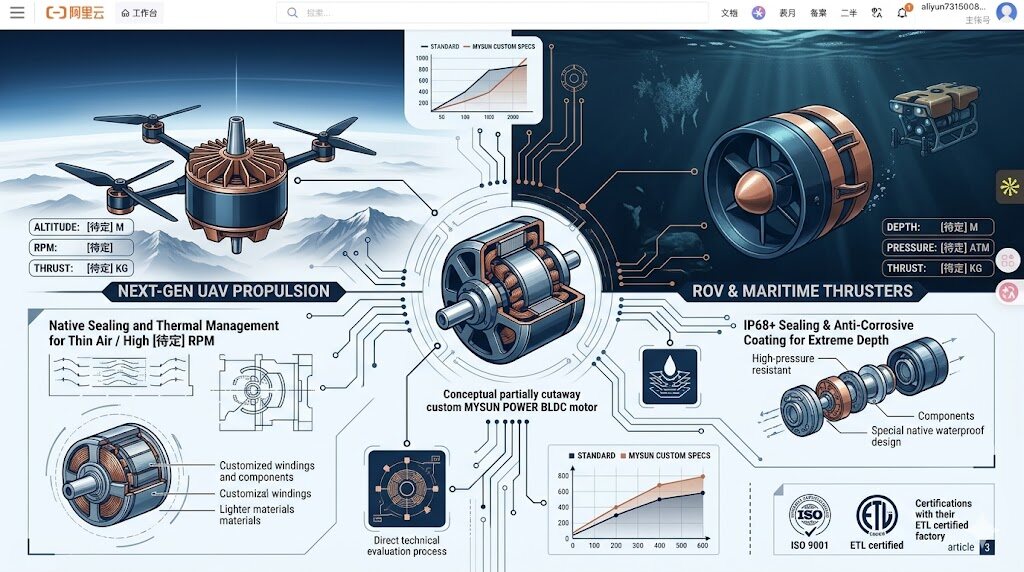
Standard industrial motors are designed for predictable, ambient environments. However, systems deployed in UAVs (Unmanned Aerial Vehicles) or underwater applications face different physical realities. Addressing these challenges may require fundamental shifts in motor architecture rather than superficial modifications.
For subsea applications, relying solely on external O-rings for water resistance may not be sufficient in high-pressure, corrosive environments. Subsea motor development may require consideration of encapsulation approaches and corrosion-resistant surface treatments. Project-specific sealing, depth rating and material requirements should be confirmed through engineering review.
Conversely, UAV propulsion systems face the challenge of thermal management in thin, high-altitude air where standard convective cooling may be less effective. Design considerations for UAV applications can include weight optimization and thermal management approaches to maintain performance under sustained operation. Project-specific requirements should be evaluated through engineering review.