
High-Torque Frameless BLDC Motors for Robotic Joints & Exoskeletons
A technical overview of frameless BLDC motor design considerations for robotic joints and actuation systems, including torque density, hollow bore design, and integration requirements.
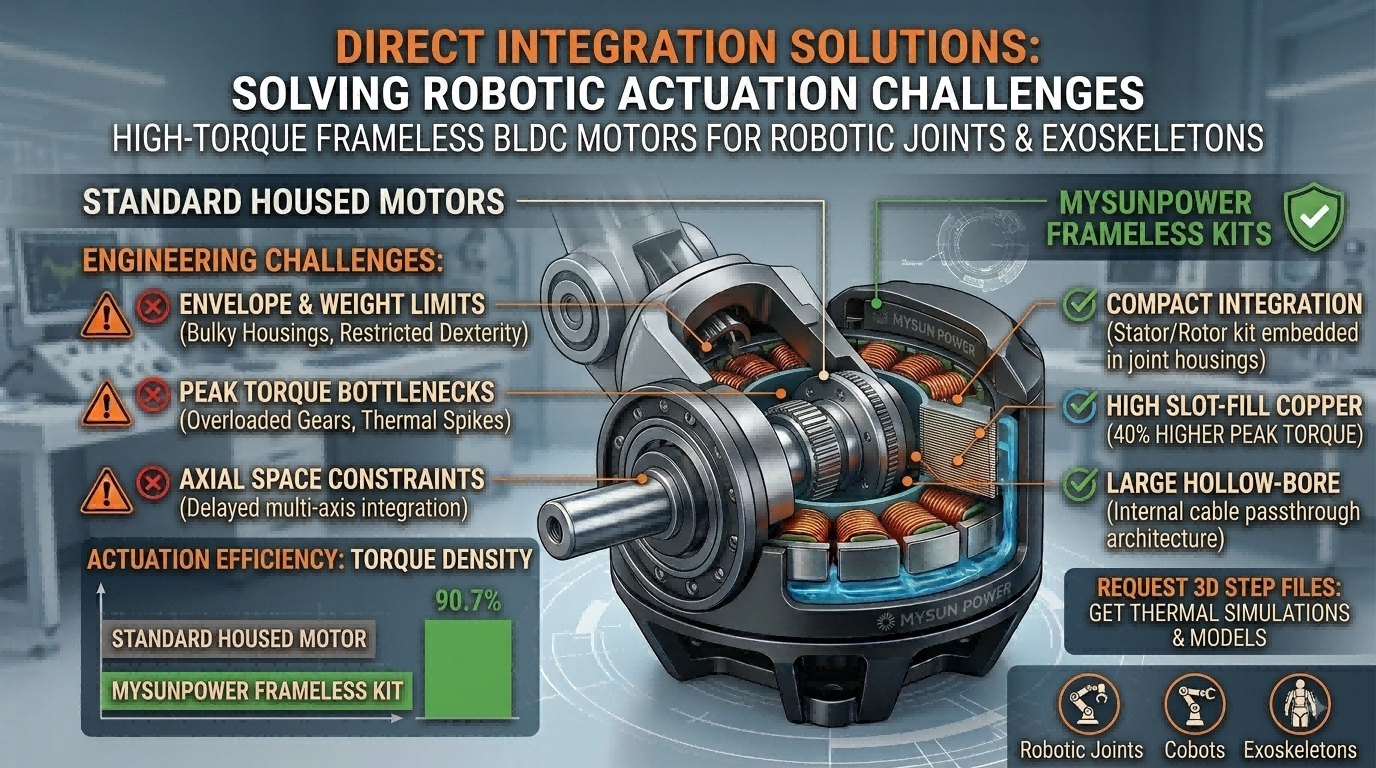
Engineering Challenges in Robotic Actuation
Frameless BLDC motors in robotic joints and exoskeletons face three critical constraints:
Envelope & Weight Limits: Conventional housed motors add dead weight and restrict joint dexterity.
Peak Torque Bottlenecks: Inadequate torque density overloads strain wave gearing and causes thermal spikes during heavy payloads.
Axial Space Constraints: Traditional motor lengths prevent compact, multi-axis joint integration.
Technical Comparison
Feature | Standard Housed Motors | MYSUN POWER Frameless Kits |
Integration | Standalone housed assembly | Stator/Rotor kit directly embedded into joint housings |
Torque Density | Standard slot fill | High-slot-fill copper windings (40% higher peak torque) |
Wiring Architecture | External side cable routing | Large hollow-bore shaft for internal cable passthrough |
Key Specifications & Customization
Operating Voltage: 12V–48V DC (Low-voltage battery operation)
Form Factor: Optimized ID/OD ratios for harmonic & cycloidal reducers
Customization Scope: Winding KV matching, temperature sensor integration, and encoder magnet rings.
Looking for Custom Motor Engineering & Prototyping?
Guangdong MYSUN Power Technology Co., Ltd. provides customized HVAC BLDC, AC, and precision geared motor solutions with engineering proposals delivered in 14–30 days.