High-Torque BLDC Motors vs. AC Induction in Industrial HVAC: Efficiency & ROI Analysis
Published on July 21, 2026
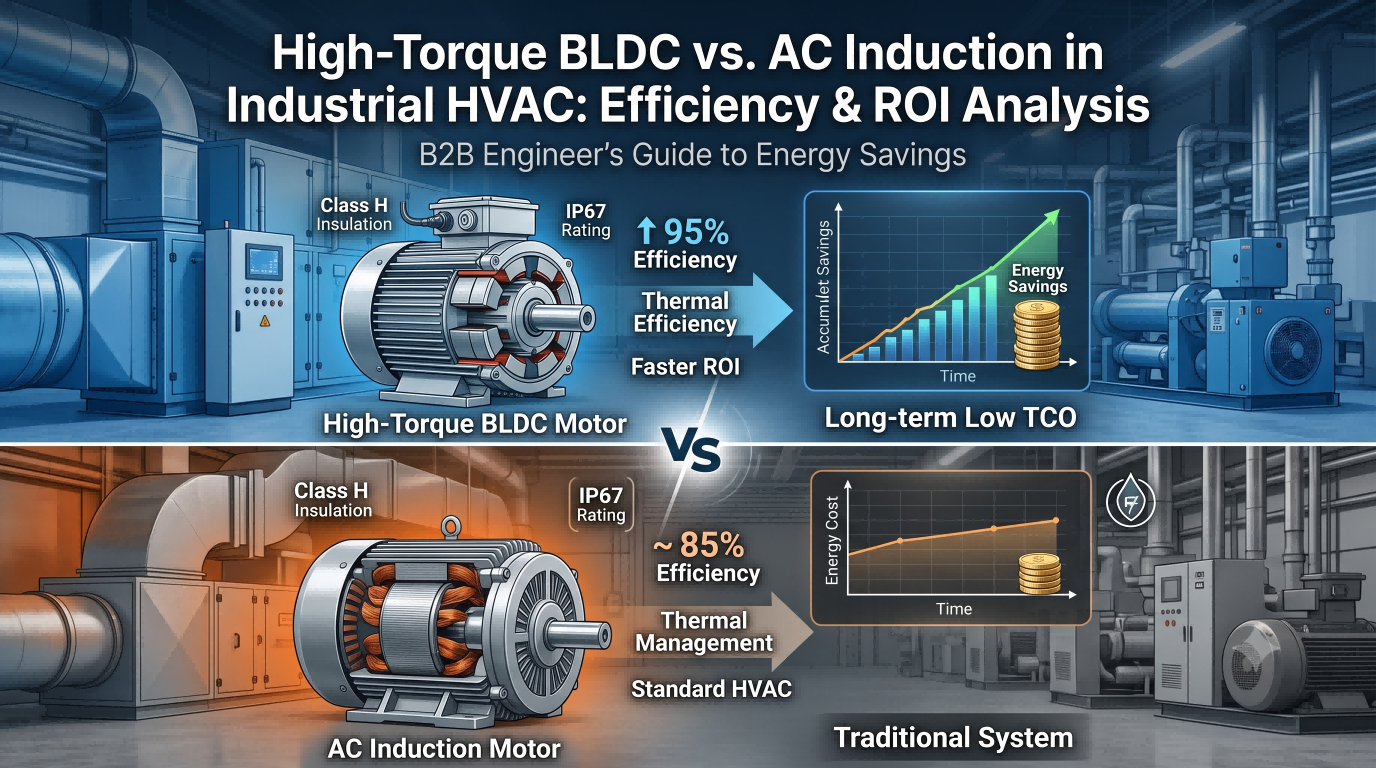
Industrial HVAC systems are among the largest power consumers in commercial buildings, manufacturing plants, and heavy-duty industrial facilities. Operating continuously under continuous or dynamic loads, these ventilation and climate control networks place extreme demands on their electric motors.
For decades, standard AC induction motors paired with Variable Frequency Drives (VFDs) were the industry benchmark. However, as energy costs rise and global regulations strictly target carbon emissions, system engineers and procurement officers are increasingly transitioning to High-Torque Brushless DC (BLDC) motors.
This article evaluates the core differences between BLDC and AC induction motors, focusing on energy efficiency, thermal management, total cost of ownership (TCO), and concrete Return on Investment (ROI) metrics.
---
Core Technical Differences: BLDC vs. AC Induction
Understanding the architectural differences explains why BLDC motors deliver superior performance in continuous-duty HVAC installations.
* Rotor Design: AC induction motors rely on alternating current to induce a magnetic field in the rotor, resulting in inherent "rotor slip" and energy losses. In contrast, BLDC motors utilize permanent magnets on the rotor, eliminating rotor copper losses entirely.
* Commutation: AC motors depend on line voltage frequency or complex external VFD inverter switching. BLDC motors utilize electronic commutation driven by precise Hall sensors or sensorless controllers, maximizing motor torque across variable speed ranges.
* Size and Torque Density: Due to permanent magnet integration, high-torque BLDC motors achieve much higher torque-to-weight and power-density ratios, allowing for compact direct-drive integration without bulky gear reductions.
---
Thermal Management and Extreme Environment Reliability
Heat is the primary cause of motor insulation degradation and premature bearing failure in industrial ventilation.
Thermal Loss Comparison
In AC induction motors, high rotor currents generate continuous heat within the motor core. This thermal output forces internal components to operate at elevated temperatures, often requiring larger cooling fans that draw additional parasitical power.
BLDC motors experience minimal rotor heat generation because heat creation is primarily confined to the outer stator windings. Heat is much easier to dissipate through external motor housing fins or liquid-cooling jackets.
### Class H/F Insulation & Extreme Conditions
For heavy-duty HVAC systems running under harsh ambient conditions (e.g., high humidity, high ambient heat, or chemical exposure), high-torque BLDC motors constructed with Class H (180°C) or Class F (155°C) insulation and IP65/IP67 ingress protection ensure uninterrupted operation and dramatically longer mean time between failures (MTBF).
---
Financial Analysis: Total Cost of Ownership (TCO) & ROI
While the initial procurement cost of a high-torque BLDC system (motor + electronic driver) is higher than a standard AC induction motor, focusing solely on CAPEX is a costly oversight for B2B buyers. Energy consumption accounts for up to 90% of an industrial motor’s lifetime operational expense.
Comparative ROI Calculation Model
Below is a realistic 2-year operational scenario comparing a standard 10 kW AC Induction Motor system against a High-Torque BLDC system operating 24/7 in an industrial ventilation setup:
| Parameter | AC Induction Motor (with VFD) | High-Torque BLDC Motor |
| Nominal Power Rating | 10 kW | 10 kW |
| System Efficiency | ~82% - 85% | ~92% - 95% |
| Operating Hours / Year | 8,760 Hours (24/7) | 8,760 Hours (24/7) |
| Annual Energy Draw | ~103,000 kWh | ~92,200 kWh |
| Annual Energy Savings | Base | ~10,800 kWh / year |
(Assuming an industrial electricity rate of $0.12 per kWh)
* Direct Energy Cost Savings: ~**$1,296 USD / year** per motor unit.
* Maintenance & Bearing Savings: Reduced heat and vibration yield approximately $300 - $500 USD in annualized maintenance savings.
* Payback Period: The initial price differential for a BLDC system is typically recouped within 10 to 14 months of continuous operation.
---
Strategic Recommendation for System OEMs and Engineers
Transitioning to high-torque BLDC motors in industrial HVAC configurations delivers clear operational advantages:
1. Lower Operating Amperage: Reduces thermal stress on electrical distribution panels and back-up power systems.
2. Precision Dynamic Control: Smooth, linear torque curves enable exact airflow management without mechanical dampeners or stepped throttling.
3. Direct-Drive Capability: Eliminates belts, pulleys, and gearboxes, reducing mechanical points of failure and maintenance downtime.
For system integrators seeking to lower operational expenses and meet strict modern efficiency targets, upgrading to high-efficiency BLDC propulsion systems offers the shortest path to sustainable ROI.