The "Compatibility Tax" in Commercial HVAC: Why Parameter-Driven BLDC Motor Integration is the Only
Published on July 6, 2026
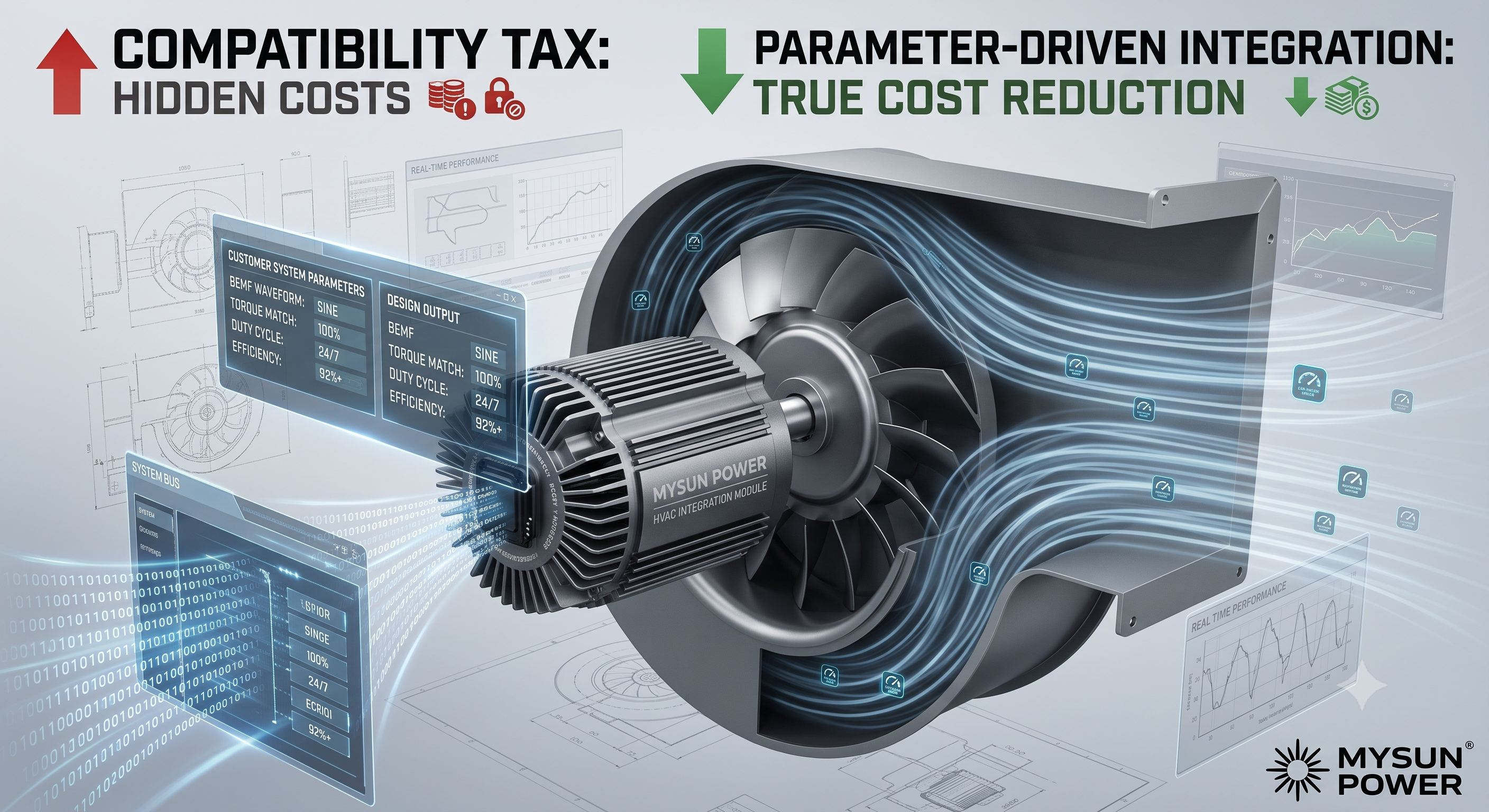
In R&D and procurement meetings for commercial HVAC systems, the initial BOM cost is usually the center of attention. To squeeze this number, many equipment manufacturers opt for standard, off-the-shelf Brushless DC (BLDC) motors. However, a brutal truth is often ignored: standard products are frequently the most expensive.
The money saved upfront on hardware is eventually paid back with interest through hidden expenses. At MYSUN POWER, we call this the "Compatibility Tax."
What is the "Compatibility Tax" in HVAC Systems?
When you force a standard motor—one not tailored for your specific system—into a commercial fresh air unit, condenser fan, or precision AC, you are paying this tax. It typically manifests in three fatal areas:
1. The Electro-Mechanical Tuning Abyss A standard motor has fixed Back-EMF (BEMF) waveforms and inductance parameters, while your controller has specific logic. To prevent resonance, step-loss, or abnormal heating, your engineers are forced to waste weeks tweaking PID parameters and rewriting core algorithms. In R&D, time is the highest cost.
2. Structural Compromises and Aerodynamic Loss To accommodate a standard motor's mounting holes, shaft diameter, and wiring, you may need to add adapter plates or alter the fan blade design. This not only adds redundant mechanical weight but also directly disrupts the optimal aerodynamic architecture of your HVAC system.
3. Mismatched Load Profiles The torque curve and rated speed of a standard motor rarely match your actual system load profiles 100%. The motor either runs in an inefficient zone—causing the overall system to fail EER/COP targets—or it overheats under extreme duty cycles, burying long-term reliability risks.
Breaking the Deadlock: Parameter-Driven Integration
True cost reduction doesn't come from shaving pennies off the motor's unit price; it comes from eliminating redundancy at the system integration stage. MYSUN POWER rejects the "one-size-fits-all" approach. We champion Parameter-Driven Integration.
In the early stages of a project, we don't rush to pitch a catalog motor. Instead, we demand your core system parameters: What is the true static pressure requirement? Is the controller logic square wave or sine wave? What are the duty cycles under extreme conditions? What are the ambient temperature constraints and expected lifespan?
Based on these exact boundary conditions, we translate motor design into parameter equations. From stator winding patterns and silicon steel grades to NdFeB magnet selection and precise Hall sensor positioning, every detail is dictated by your system's needs.
The Ultimate Goal: System-Level Cost Reduction
Through parameter-driven integration, MYSUN POWER delivers a powertrain module that is truly "Plug & Play" for your HVAC system.
For R&D: Engineers no longer rewrite code to accommodate the motor; tuning cycles are cut by over 70%.
For Production: Redundant mechanical adapters are eliminated, streamlining the assembly process.
For the Market: The system runs in its optimal efficiency zone with lower noise, an extended lifespan, and drastically reduced warranty claims.
Stop subsidizing standard designs. Stop paying the Compatibility Tax. Evaluate your motor supplier not by the thickness of their product catalog, but by their capability to integrate deeply into your system's architecture.