
Why Industrial Drones Overheat: 5 Motor Customization Pitfalls to Avoid
Published on August 4, 2026
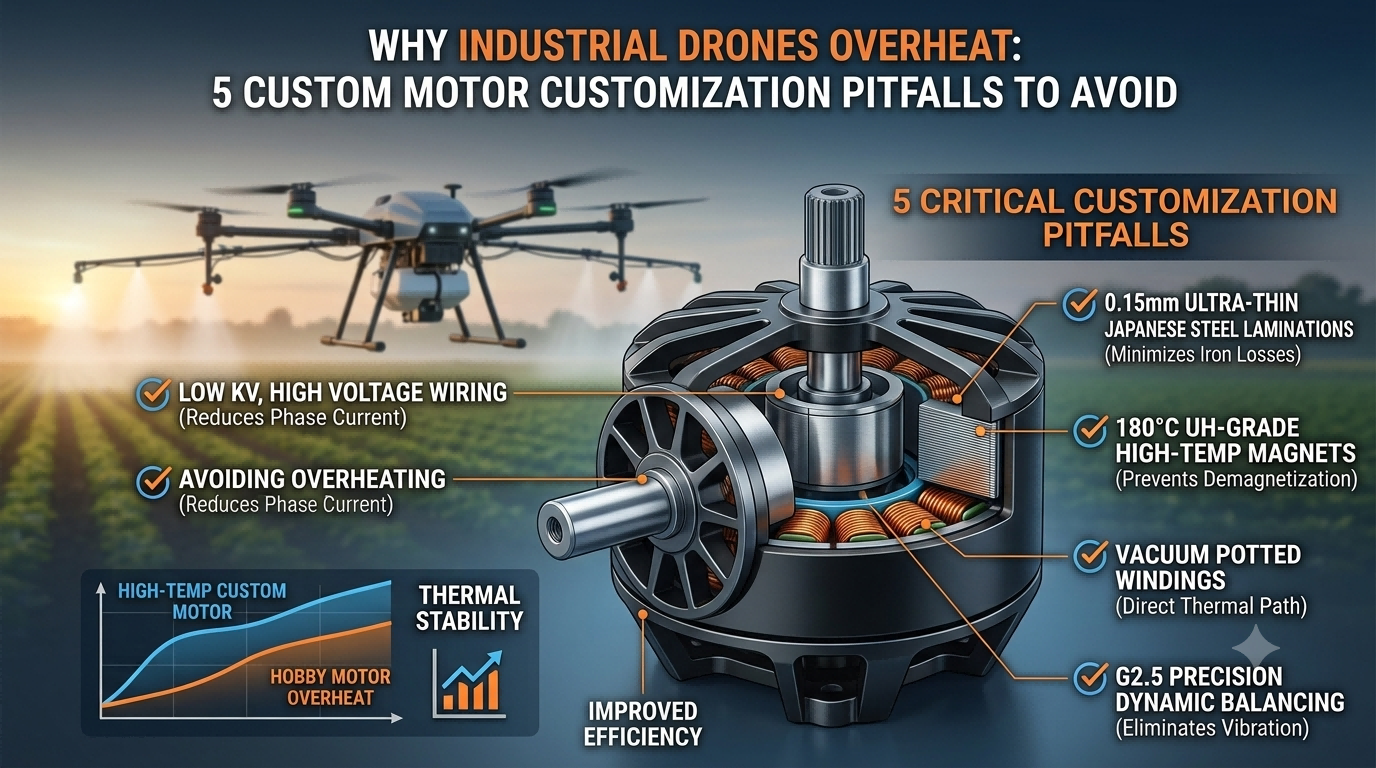
Industrial Unmanned Aerial Vehicles (UAVs)—including agricultural sprayers, heavy-lift cargo drones, and long-range inspection craft—operate under continuous high-payload conditions. Unlike consumer drones, industrial multirotors face extreme thermal stress, where unchecked motor heat quickly leads to power degradation or inflight motor failure.
Avoid these 5 critical motor customization mistakes to ensure high thrust efficiency and long-term thermal stability.
1. Oversizing KV Parameters for Heavy Payloads
The Pitfall: Selecting a high KV motor to achieve high RPM on large propellers.
The Fix: Heavy-lift drones require high continuous torque at low RPMs. Specifying a low-KV motor paired with higher operating voltage (e.g., 12S to 18S LiPo) reduces phase current ($I$) draw, exponentially cutting thermal resistance losses ($I^2R$).
2. Ignoring Magnet Thermal Limits (N52 vs. SH/UH Grades)
The Pitfall: Using high-magnetic-density Neodymium magnets (like N52) rated only up to 80°C.
The Fix: Under sustained continuous loads, internal rotor temperatures can easily cross 100°C, causing irreversible demagnetization. Specify high-temperature magnet grades (such as SH rated to 150°C or UH rated to 180°C) with multi-layer anti-corrosion coatings.
3. Suboptimal Stator Laminations & Iron Losses
The Pitfall: Using standard 0.35mm silicon steel laminations for high-frequency switching.
The Fix: Eddy current losses (heat generated within the iron core) scale rapidly with frequency. Custom industrial drone BLDC motors should utilize ultra-thin 0.2mm or 0.15mm Japanese silicon steel laminations to minimize iron losses and maximize motor efficiency.
4. Poor Thermal Conduction Paths in Encapsulated Coils
The Pitfall: Relying solely on ambient propeller downwash for stator cooling.
The Fix: External airflow cannot effectively cool the core of tightly wound stator coils. Incorporating high-thermal-conductivity epoxy potting materials directly transfers internal heat from the copper windings to the outer CNC aluminum housing.
5. Overlooking High-RPM Dynamic Balancing Standards
The Pitfall: Accepting standard static balancing for large-diameter multirotor motors.
The Fix: Unbalanced rotors introduce micro-vibrations that degrade flight controller IMU data and destroy ball bearings under heavy loads. Demand dynamic balancing standards of G2.5 or better across full operating RPM ranges.
Quick Customization Checklist
Parameter | Off-the-Shelf Hobby Motor | Custom Industrial BLDC Motor |
Magnet Grade | N52 (Max 80°C) | 45SH / 42UH (150°C–180°C) |
Stator Lamination | 0.35mm Standard | 0.2mm / 0.15mm Low-Loss Steel |
Thermal Protection | Air cooling only | High-TIM Vacuum Potting |
Dynamic Balance | G6.3 baseline | G2.5 High-Precision Dynamic |
Conclusion
Optimizing industrial UAV motors requires balancing thermal endurance, electromagnetic efficiency, and mechanical precision. Avoiding these common design pitfalls ensures maximum flight time, increased payload capacity, and total mission reliability.
Need custom motor winding or thermal optimization for your drone platform? Contact our UAV powertrain specialists today.