
Integrated Drive vs. External Controller in Heavy-Duty HVAC Systems: Which Saves More Energy?
Published on August 4, 2026
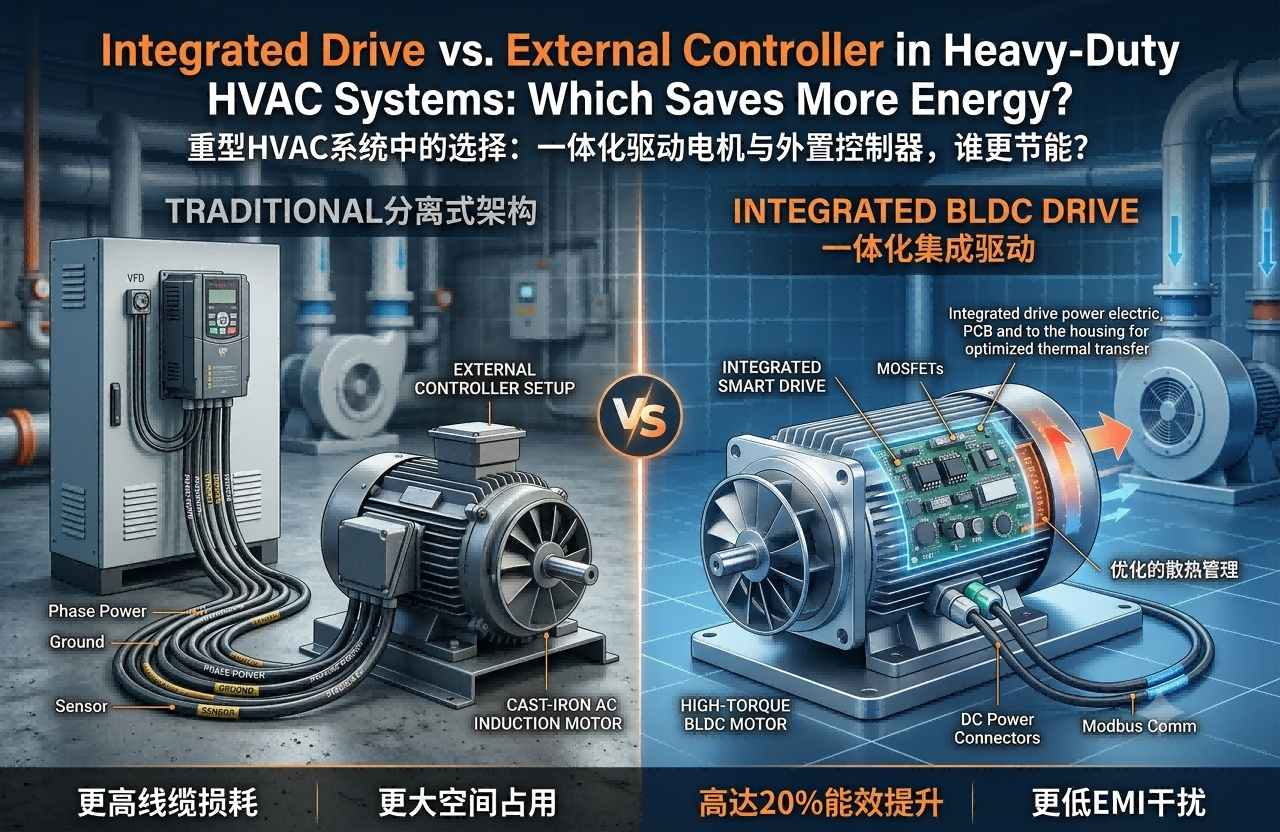
Transitioning commercial HVAC systems to high-efficiency Brushless DC (BLDC) motors requires choosing between two main drive architectures: Integrated Drive Motors or Separated External Controllers.
Here is a quick evaluation of how integrated drives deliver superior system performance and lower operating costs.
1. Electrical Efficiency & Cable Losses
Reduced Resistance: External setups require long phase cables, inducing continuous copper ($I^2R$) losses. Integrated drives eliminate long phase wiring, maximizing wall-to-shaft efficiency.
Harmonic Mitigation: Shorter internal wiring confines high-frequency switching harmonics, reducing electrical noise across the system.
2. EMI Suppression & Compact Footprint
Built-in EMC Compliance: Mounting the drive directly onto the motor housing reduces the high-power AC loop to millimeters, dramatically cutting EMI without costly external shielding or ferrite filters.
Cabinet Space Savings: Eliminating external variable frequency drives (VFDs) shrinks electrical enclosure size, simplifying field wiring to basic power and communication lines (e.g., Modbus/CAN).
3. Thermal & Environmental Protection
Active Structural Cooling: Heavy-duty integrated drives utilize direct thermal interface materials (TIM) bonded to die-cast aluminum end-caps, using system airflow for cooling.
Enhanced Durability: Sharing an IP65/IP66 enclosure protects sensitive drive silicon from industrial HVAC dust, condensation, and vibration.
Summary Comparison
Metric | External Controller | Integrated BLDC Drive |
Wiring Complexity | High (Phase power + Sensors) | Low (Power bus + Modbus) |
System Footprint | Large cabinet needed | Inline compact assembly |
EMI Mitigation | Expensive shielding required | Self-contained / Shielded |
5-Year TCO | Standard baseline | 15–22% Energy & Labor Savings |
Conclusion
For modern commercial HVAC platforms, Integrated BLDC Drive Architectures provide higher energy efficiency, easier installation, and lower lifetime operating costs.
Need a custom motor-drive integration assessment for your HVAC project? Contact our engineering team today.