Beyond the Datasheet: Why a Parameter-Driven Approach is the Future of BLDC Integration
Published on July 6, 2026
1. The Trap of "Close Enough" Specs
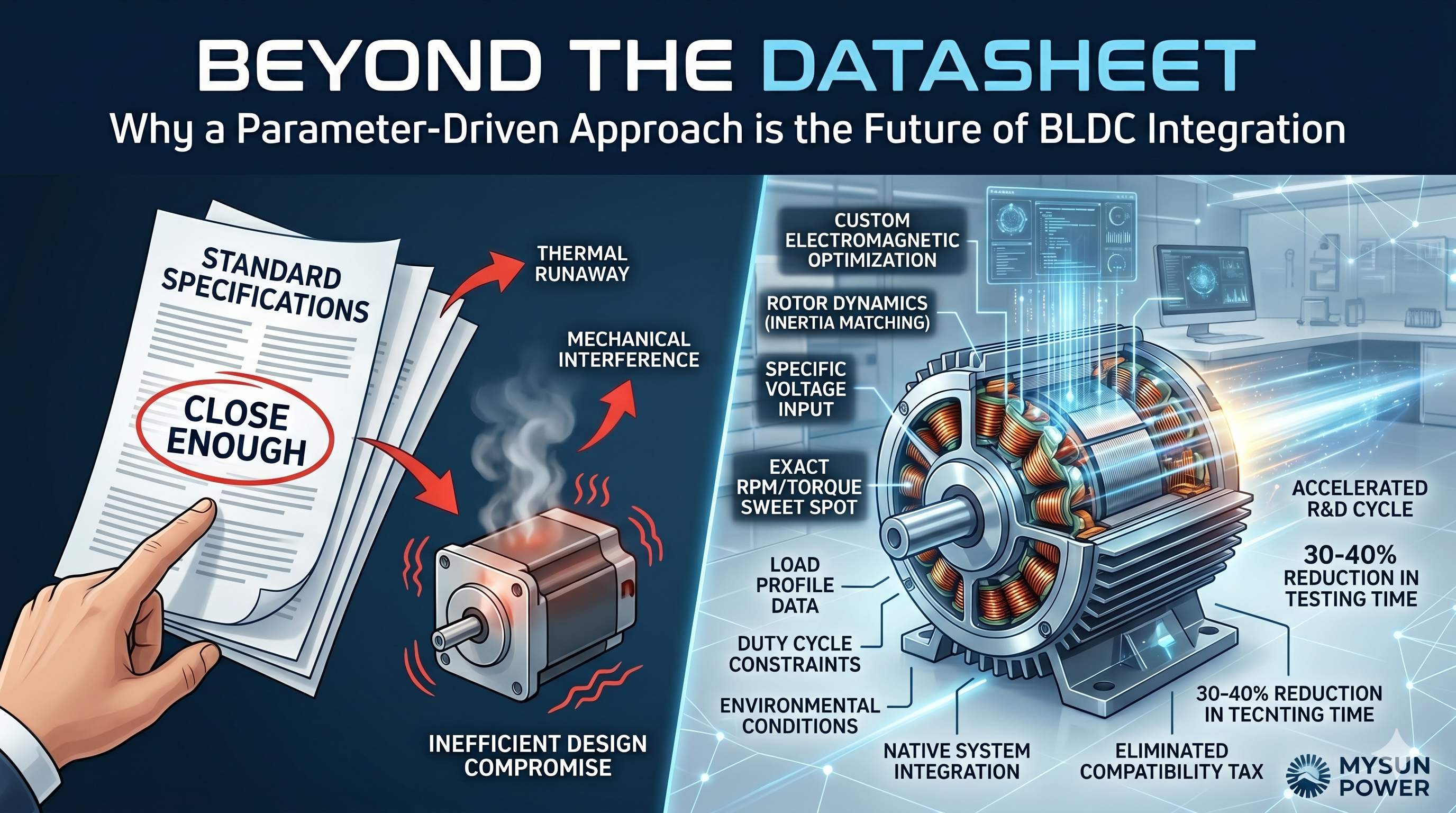
In the early stages of R&D, it is tempting to select a motor that is "close enough" to your requirements from a standard datasheet. However, in high-performance applications-like surgical robotics or high-altitude drones-"close enough" often leads to thermal runaway, excessive vibration, or mechanical interference. A datasheet is a static snapshot; a parameter-driven approach is a dynamic solution.
2. Defining the Parameter-Driven Framework
What does it mean to be "Parameter-Driven"? At MYSUN POWER, it means we do not start with a product; we start with your Boundary Conditions. We ask for your specific load profiles, duty cycles, and environmental constraints. We translate these into three core engineering pillars:
- Electromagnetic Optimization: Adjusting winding patterns to hit the exact RPM/Torque sweet spot for your specific voltage input.
- Rotor Dynamics: Customizing rotor inertia to ensure rapid acceleration and deceleration without overshooting the target position.
- Thermal Management: Designing housing fins and material selection based on your specific airflow and ambient temperature conditions.
3. Eliminating the "Compatibility Tax"
When you use a standard motor, you often pay a "compatibility tax"-the extra time and money spent designing brackets, gearboxes, or complex cooling loops to fix the motor's shortcomings. By transmitting precise parameters directly to our factory, you eliminate these redundancies. The motor becomes a native part of your system architecture, not an afterthought.
4. Accelerating the R&D Cycle
Precision matching at the source drastically reduces the number of prototype iterations. Our clients typically report a 30-40% reduction in testing time because the motor's performance has been pre-validated against their specific system parameters before it even leaves our facility. This is not just manufacturing; it is proactive engineering support.
5. Conclusion: Data-First Manufacturing
The era of picking motors from a catalog is fading for high-stakes industries. By adopting a parameter-driven approach, you gain a competitive advantage in efficiency, reliability, and speed-to-market. Stop compromising your design to fit a motor; let us design the motor to fit your vision.