Engineering the Quietest Home HVAC Systems: How Parameter-Driven BLDC Integration Optimizes Resident
Published on July 6, 2026
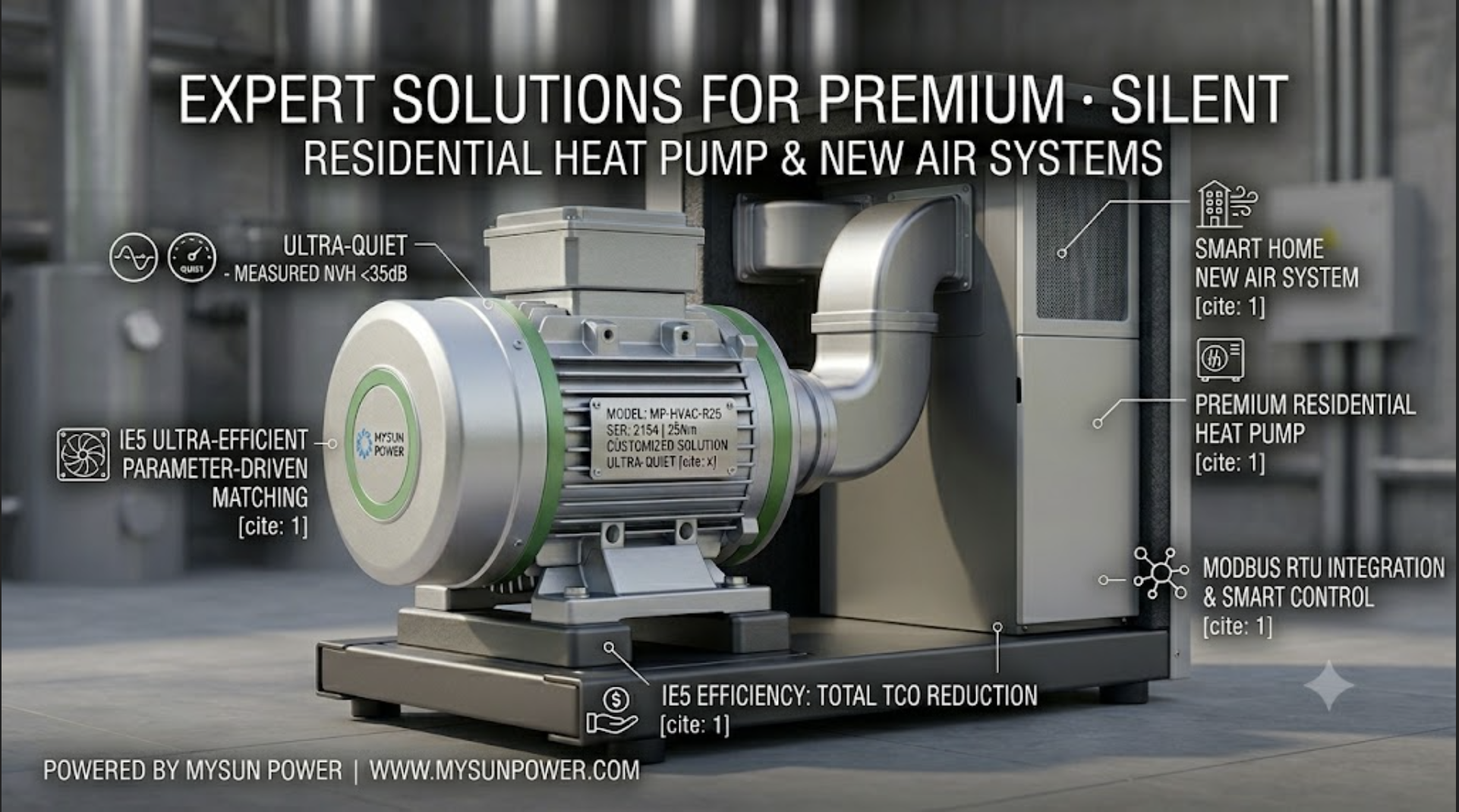
In the luxury residential market, a home is more than just a building—it is a sanctuary. As homeowners invest in high-efficiency heat pumps, advanced energy recovery ventilators (ERVs), and smart air purification systems, their expectations for comfort have shifted. It is no longer enough for an HVAC system to be powerful; it must be invisible and, above all, silent.
However, many high-end residential HVAC OEMs face a recurring challenge: electromagnetic hum and structural vibration. This is the hallmark of the Residential Compatibility Tax—the cost of forcing a standard catalog motor into a premium home environment.
The Silent Enemy: Electromagnetic NVH
Noise, Vibration, and Harshness (NVH) are the primary metrics for residential comfort. Standard catalog BLDC motors are designed for broad industrial or general-purpose use. When these motors are integrated into the thin-walled cabinets of home heat pumps or ceiling-mounted fan coil units, their inherent electromagnetic excitation frequencies often align with the mechanical resonance of the fan blades or the housing.
The result is a persistent, low-frequency drone that resonates through the home’s ductwork. Using standard motors means OEMs must resort to heavy acoustic insulation or complex vibration dampening—workarounds that increase unit size and cost without solving the root cause.
Compact Design vs. Thermal Constraints
Modern smart homes demand sleeker, more compact HVAC units to fit into tight attic spaces or hidden closet compartments. Standard motors, which are often "over-engineered" in size to cover a wide range of applications, consume valuable space and complicate airflow paths.
By shifting to a Parameter-Driven Integration, the motor’s physical form factor and electromagnetic stack are rightsized for the specific air-handler geometry. This not only allows for a more compact system design but also optimizes the thermal dissipation path, ensuring the motor runs cool even in restricted, non-ventilated residential enclosures.
Eliminating the Home Compatibility Tax
For residential HVAC brands, the Compatibility Tax manifests as:
1. Customer Dissatisfaction: Warranty claims and negative reviews due to operational noise.
2. Increased Bill of Materials (BOM): Excess spending on sound-proofing materials to mask a poor motor match.
3. Energy Rating Caps: Standard motors failing to reach the highest SEER2 or HSPF2 ratings due to mismatched torque-speed efficiency.
By moving away from catalogs and embracing technical matching, OEMs can deliver a "true luxury" experience where the power system is felt (through perfect temperature) but never heard.
The 6-Field Matching Framework for Residential Comfort
At MYSUN POWER, we optimize residential powertrains by aligning with six specific boundary fields to ensure a seamless "silent" fit:
Electrical Boundaries: Precision tuning of current ripple and switching frequency to eliminate high-frequency squeal.
Control Sensitivity: Smooth, jitter-free speed transitions to avoid abrupt acoustic changes during ramp-up.
Torque-Speed Envelope: Optimized efficiency for the specific static pressure of residential ductwork.
Mechanical Precision: Zero-tolerance balancing of the rotor and shaft to eliminate structural resonance.
Acoustic Targets (NVH): Designing the electromagnetic profile to stay clear of the system’s natural resonant frequencies.
Space/Thermal Constraints: Tailoring the motor housing to fit the most compact luxury unit footprints.
Conclusion: Silent Power, Pure Comfort
In the residential HVAC sector, the difference between a standard product and a premium solution lies in the engineering of the details. To build the next generation of ultra-quiet heat pumps and smart air handlers, we must move beyond the motor catalog.
By embracing parameter-driven BLDC integration, residential OEMs can finally eliminate the Compatibility Tax, unlock new levels of acoustic comfort, and provide homeowners with the silent, efficient sanctuary they expect.