Engineering for Extremes: Reliable Propulsion Solutions for Deep-Sea ROVs
Published on July 6, 2026
Operating a Remotely Operated Vehicle (ROV) at significant depths requires propulsion systems that go beyond standard engineering limits.
In deep-water environments, hydrostatic pressure and saline corrosion are persistent challenges. For marine engineers and ROV developers, selecting an "off-the-shelf" motor without considering the specific application environment can present operational risks.
Subsea reliability may require parameter-driven Brushless DC (BLDC) motor integration, where components are evaluated for the specific operating environment. Project-specific requirements should be confirmed through engineering review.
Hydrostatic Pressure Considerations
At significant depths, equipment faces substantial hydrostatic pressure. Standard sealed motors may not be designed for these forces, and dynamic shaft seals can be a potential failure point in subsea conditions.
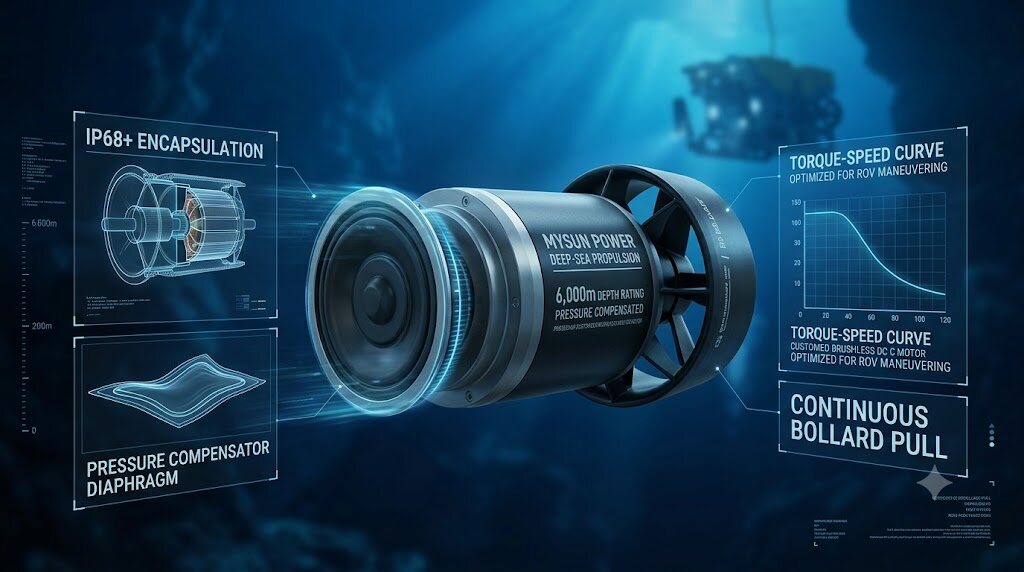
Some ROV propulsion systems use Pressure Compensation Technology. Instead of utilizing thick metallic walls to resist pressure, the motor enclosures can be oil-filled. A flexible compensator allows the internal fluid volume to balance with the external hydrostatic pressure. This approach aims to create a "pressure-neutral" state, though specific performance depends on project parameters and should be confirmed through engineering review.
Corrosion Resistance and Material Selection
Seawater can accelerate galvanic corrosion that may affect standard motor housings over time. Subsea motor applications may benefit from a multi-layered approach to corrosion management:
Encapsulation: Internal electromagnetic components (stator windings) can undergo vacuum potting and encapsulation processes to help isolate them from moisture ingress. Specific protection levels depend on project requirements.
Material Options: Outer housings may be constructed from corrosion-resistant alloys such as anodized aluminum or titanium, depending on the project's specific lifespan and budget requirements. Material selection should be confirmed through engineering review.
Magnetic Coupling (Where Applicable): In some designs, magnetic coupling can be used to transmit torque, potentially reducing the need for dynamic physical shafts passing through the hull. Feasibility depends on specific application parameters.
Hydrodynamic Efficiency and Thrust Considerations
In subsea applications, maneuvering against currents requires sustained torque and power. Parameter-driven motor integration can focus on optimizing thrust output based on the specific hydrodynamic profile of the ROV's propellers. Electromagnetic matching of voltage constants (KV ratings) and torque-speed curves should be evaluated based on application-specific requirements.
Conclusion
When designing for deep-sea applications, thorough engineering evaluation is important. Project-specific voltage, power, speed, torque, sealing, corrosion resistance and operating-depth requirements must be confirmed through engineering review. Custom BLDC motor development for subsea propulsion applications is available, subject to technical evaluation of your specific project needs.