Standard Specs vs. Custom Requirements: How to Choose the Right Motor for Your Project
Published on July 6, 2026
In the early stages of product development, engineers and project managers often face a critical crossroads: Should we source a standard, off-the-shelf motor from a catalog, or invest in a custom-integrated solution?
While standard components offer the allure of immediate availability, the long-term success of an OEM project often hinges on the precise alignment between the motor and its application. This guide breaks down the strategic factors you must consider to make the right choice for your assembly line.
When Standard "Off-the-Shelf" Motors Make Sense
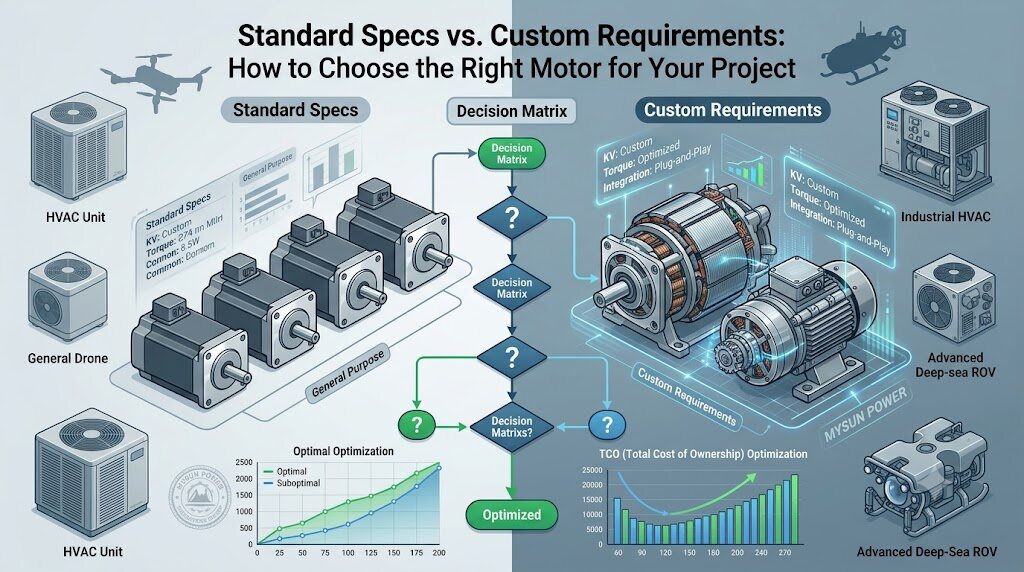
Standard catalog motors are designed to be generalists. They are manufactured in high volumes to meet a broad range of "average" requirements. A standard solution may be appropriate if your project meets the following criteria:
Generous Space Constraints: Your application enclosure has ample room for external mounting brackets and adapters.
Standard Operating Environments: The motor will not be exposed to extreme temperatures, high pressure, or corrosive agents.
Low Performance Sensitivity: Minor inefficiencies in torque-speed curves or power consumption will not compromise the final product’s marketability.
The Hidden Risks of Catalog Procurement
The primary danger of relying on standard specs is the "Integration Gap." Because a catalog motor wasn't designed for your specific device, your engineering team must compensate for its limitations. This often results in:
Sub-optimal Performance: A standard motor’s KV rating or torque profile might be "close enough," but it will rarely operate at the peak efficiency point of your specific load, leading to wasted energy and heat buildup.
Increased Part Count: You may need to design and source secondary components—shaft couplers, specialized mounting hardware, and separate cooling systems—just to bridge the gap between the motor and your machine.
Software Hurdles: Standard Electronic Speed Controllers (ESCs) may not support the exact communication protocols or safety logic your system requires.
The Case for Custom Integration
Custom motor integration is not just about changing a dimension; it is about electromagnetic and mechanical synergy. By choosing a custom-integrated solution, you are designing the "heart" of your machine to beat in perfect rhythm with the rest of the system.
1. Precision Parameter Matching Instead of picking the closest match from a list, a custom integrator calibrates the motor’s internal variables—winding density, magnet strength, and stator geometry—to match your exact torque, speed, and voltage requirements.
2. Mechanical Synergy (Plug-and-Play) Custom integration allows for "zero-adapter" designs. The motor can be built with integrated mounting flanges, application-specific shaft lengths, and pre-installed wiring harnesses. This moves the complexity from your assembly line back to our factory, where it belongs.
3. Optimized Thermal Management Heat is the enemy of motor longevity. Custom solutions allow for integrated heat sinks or specialized housing materials that are optimized for your specific duty cycle and airflow environment, significantly extending the life of the product.
The Decision Matrix: A Quick Checklist
If you answer "YES" to any of the following, a custom-integrated solution is likely the more cost-effective choice in the long run:
Does my project have strict weight or size limitations?
Is high energy efficiency critical to my product's value proposition?
Will the motor operate in a harsh environment (underwater, high altitude, high vibration)?
Am I looking to simplify my internal supply chain by receiving a pre-tested, integrated drive unit?
Conclusion
A motor is never just a component; it is the primary driver of your product's reliability and user experience. While standard motors serve a purpose for prototyping or low-stakes applications, custom BLDC integration is the definitive path for OEMs looking to scale with efficiency and technical superiority.
Evaluate your parameters early, and choose a partner who understands that your project deserves more than a "standard" answer.