Reliability Beneath the Waves: Engineering BLDC Motors for Subsea ROVs and Underwater Robotics
Published on July 6, 2026
The Deep-Sea Challenge: More Than Just Water
Operating in underwater environments presents significant challenges for BLDC motors. It is not just about keeping the water out; it is about withstanding pressure, resisting corrosion, and maintaining thermal stability where traditional air-cooling may not be effective. For Subsea ROVs (Remotely Operated Vehicles), the motor is the heart of every maneuver.
Engineering Considerations for Subsea Applications
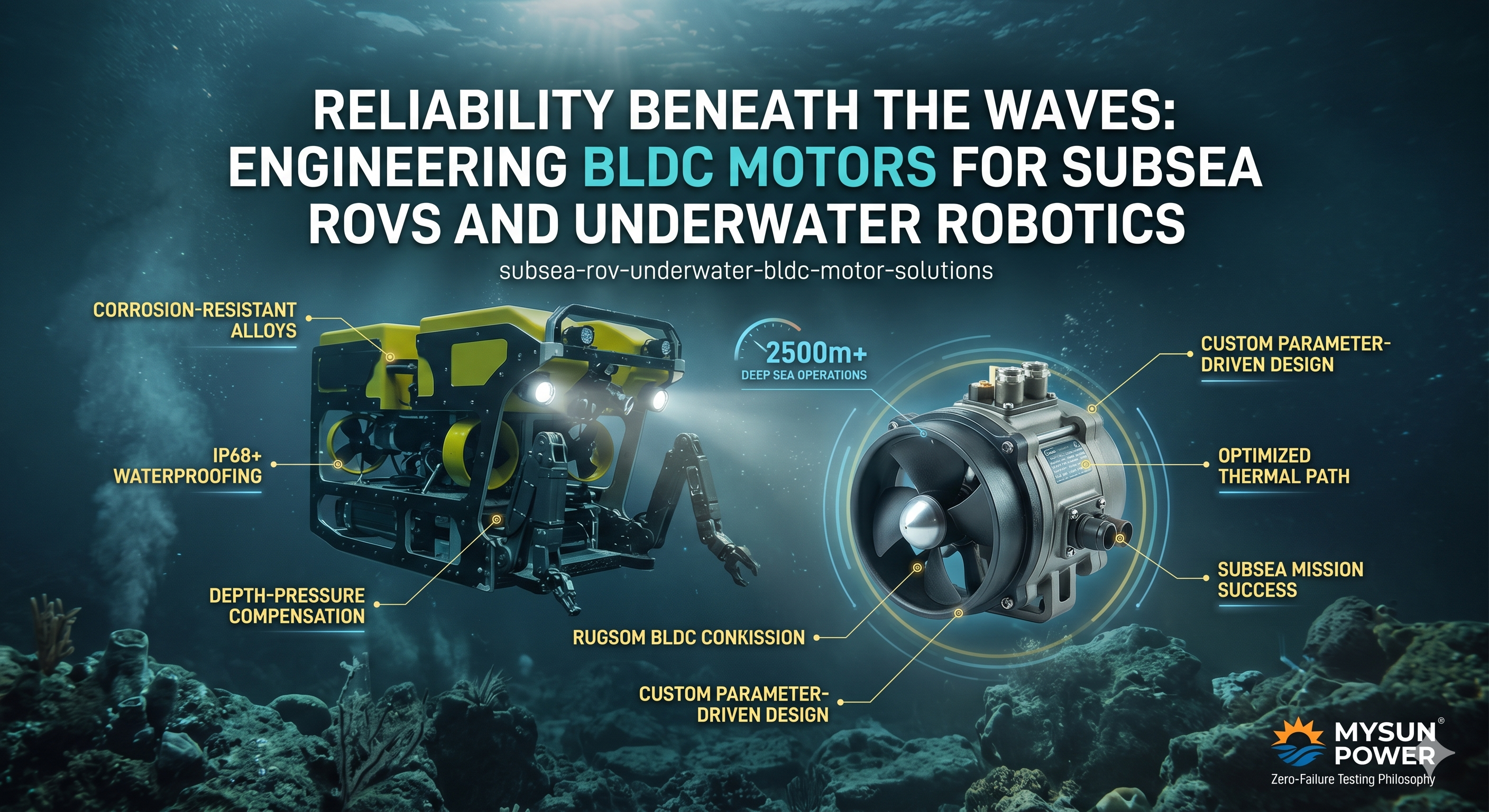
While many motors claim IP68 ratings, subsea applications may require additional engineering considerations. Our motor development support for underwater applications focuses on several key areas:
* Sealant and Encapsulation: Resin encapsulation approaches can be evaluated based on specific pressure and depth requirements. Project-specific sealing solutions should be confirmed through engineering review.
* Corrosion-Resistant Materials: Stainless steel shafts and coated housings may be specified based on the expected operating environment and duration of saltwater exposure.
* Pressure Considerations: For deeper applications, internal architectures may need to account for pressure-induced stress on bearings and rotor components. Specific depth ratings should be confirmed through engineering review.
Thermal Management in a Liquid Medium
A common misconception is that water provides unlimited cooling. Without a properly designed thermal path, heat can build up within the motor casing, leading to efficiency loss. Parameter-driven approaches to winding design can help ensure that heat is dissipated effectively through the housing, depending on the specific application requirements.
Customization for Subsea Applications
Every underwater project has unique boundary conditions—depth requirements, weight constraints, and specific power-to-torque ratios. A standard catalog motor may not be suitable because it was not designed for the specific drag coefficients of a subsea hull. Motor parameter matching to the actual fluid dynamics of your ROV should be evaluated through engineering review.
Project-Specific Requirements
For subsea applications, project-specific voltage, power, speed, torque, sealing, corrosion resistance and operating-depth requirements must be confirmed through engineering review. We support motor development for underwater propulsion applications, subject to technical evaluation of your specific project needs.