Heavy-Duty Subsea BLDC Motor Solutions for ROV & Underwater Thrusters
Published on August 8, 2026
Engineering Challenges in Deep-Sea Propulsion
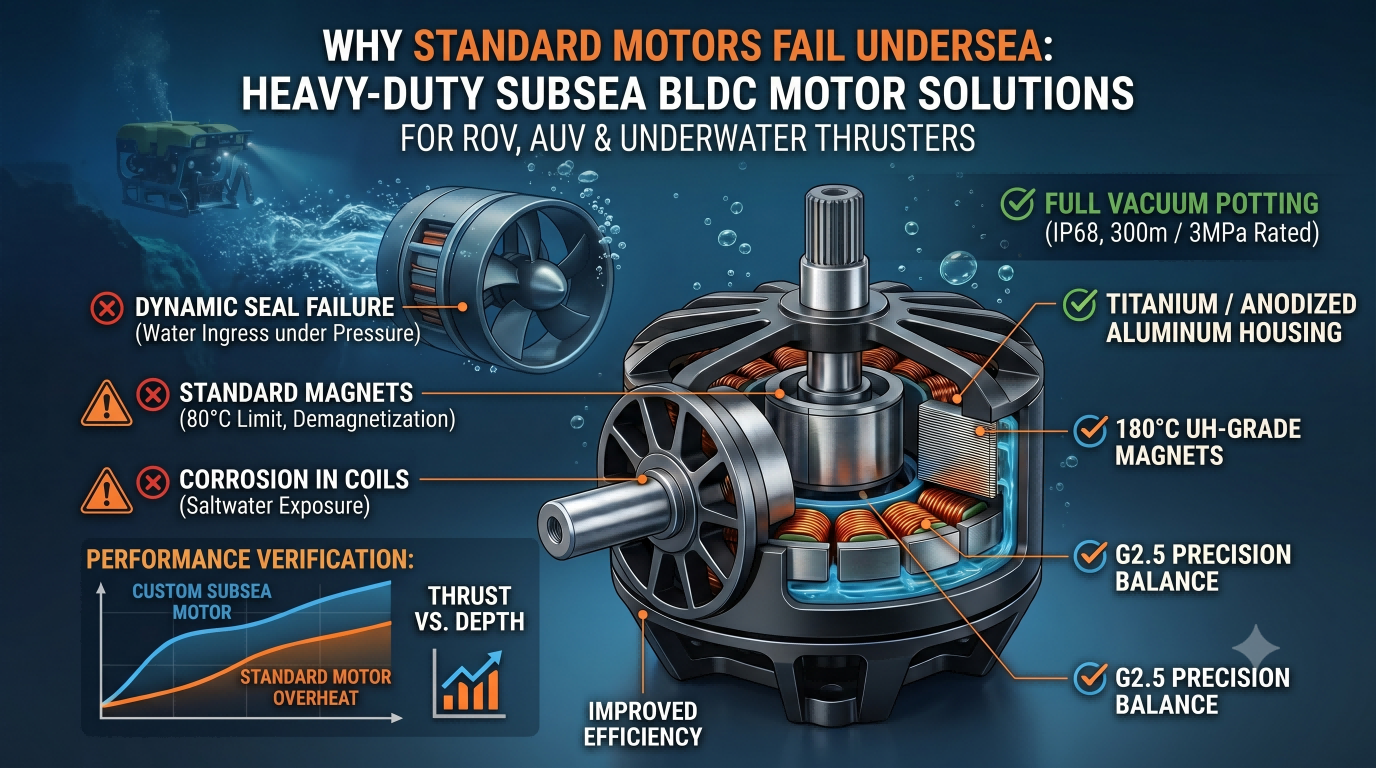
Subsea robotics and Remote Operated Vehicles (ROVs) operate in extreme marine environments where conventional industrial BLDC motors can face three critical challenges:
Water Ingress under Hydrostatic Pressure: Traditional dynamic lip seals may degrade under sustained pressure, potentially leading to fluid penetration and stator damage.
Saltwater Corrosion: High-salinity seawater can accelerate oxidation of rotor magnets and winding insulation, affecting system lifespan.
Thermal Bottlenecks: Closed subsea pressure housings can trap heat inside the motor core, potentially causing torque loss and magnetic demagnetization under sustained load.
Design Considerations for Subsea Motor Applications
Design Factor | Standard Industrial Approach | Subsea Application Considerations |
Sealing System | Standard Rubber Seals | Vacuum potting and corrosion-resistant housing materials may be required, subject to engineering review for specific depth and pressure requirements. |
Magnet Protection | Basic Nickel Plating | Higher-grade magnets with anti-corrosion coating may be specified based on operating environment and project requirements. |
Thermal Path | Air-gap convection | Enhanced thermal conduction design may be considered for enclosed subsea housings, depending on continuous load requirements. |
Shaft Material | Standard steel | Stainless Steel 316L or Titanium alloy shafts may be specified based on corrosion resistance requirements. |
Customization Parameters for Subsea Applications
We support custom motor development for underwater propulsion applications. Specifications are confirmed through engineering review based on your project requirements:
Operating Voltage: Customizable based on application requirements
Depth Rating: Project-specific, to be confirmed through engineering review
System Efficiency: Dependent on application parameters and operating conditions
Shaft & Mounting: Material and configuration customizable based on application requirements
Discuss Your Subsea Motor Requirements
If you are developing propulsion systems for underwater applications, please submit your required specifications (Operating Voltage, Target KV, Max Outer Diameter, and application environment). Our engineering team will review your requirements and discuss the technical approach.