Material Selection for Subsea ROV Motor Housings: Titanium vs. Aluminum Alloys
Published on July 29, 2026
Subsea Remotely Operated Vehicles (ROVs) and underwater thrusters operate under extreme hydrostatic pressure and aggressive saltwater corrosion. Selecting the correct material for motor housings is essential to balance depth capability, structural weight, and manufacturing cost.
The two most common alloys used in underwater propulsion enclosures are Anodized Aluminum 7075-T6 and Titanium Grade 5 (Ti-6Al-4V).
Anodized Aluminum 7075-T6: Lightweight and Cost-Effective
Aluminum 7075 offers an excellent strength-to-weight ratio, making it a popular choice for shallow to medium-depth ROV applications.
1. High Strength and Low Mass
Aluminum 7075 provides high yield strength while maintaining low density, keeping overall thruster weight low for agile subsea maneuverability.
2. Surface Protection Requirement
Raw aluminum corrodes rapidly in seawater. Hard-coat anodizing with PTFE sealing is mandatory to protect against pitting and galvanic corrosion. However, deep scratches during field operation can expose raw metal to salt spray.
Titanium Grade 5 (Ti-6Al-4V): Deep-Water Corrosion Resistance
Titanium Grade 5 is the industry standard for deep-subsea exploration and long-term marine installations.
1. Superior Corrosion Resistance
Titanium naturally forms a stable oxide film that prevents seawater corrosion indefinitely, eliminating the need for protective coatings or sacrificial anodes.
2. Extreme Depth Capability
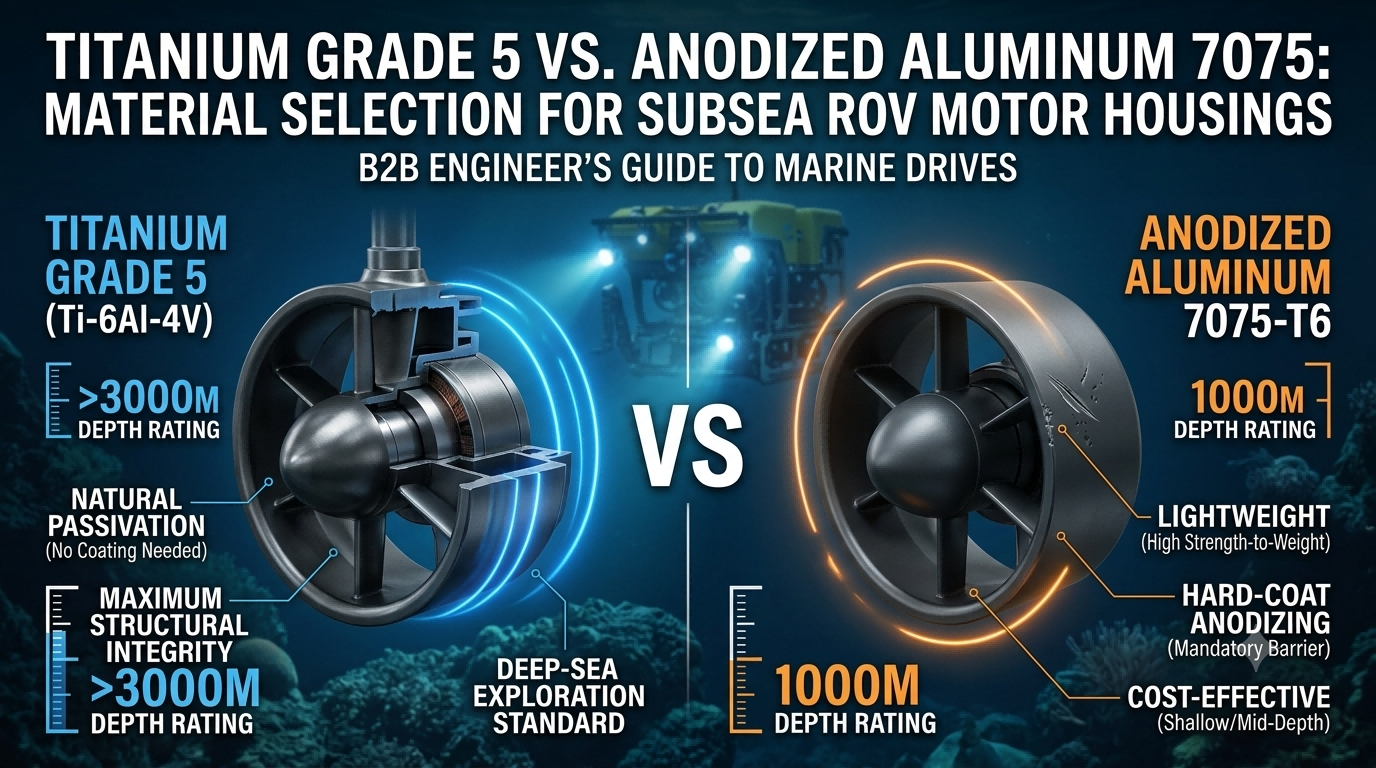
With exceptional yield strength under high hydrostatic pressure, Titanium Grade 5 housings easily support deep-subsea operations exceeding depths of 3,000 meters.
Material Selection Comparison
- Depth Rating: Aluminum 7075 is ideal for shallow to mid-depths up to 1,000 meters; Titanium Grade 5 excels in deep-sea environments beyond 3,000 meters.
- Corrosion Barrier: Aluminum relies on surface anodizing coatings; Titanium possesses natural, permanent passivation.
- Cost Consideration: Aluminum lowers initial manufacturing expenses; Titanium offers lower long-term replacement costs in harsh marine conditions.
Conclusion
For budget-sensitive, shallow-water ROV platforms, hard-anodized Aluminum 7075 is an efficient choice. For deep-sea marine robotics requiring zero corrosion maintenance and maximum structural integrity, Titanium Grade 5 provides reliable long-term performance.