
Acoustic Vibration & Phase Balance Optimization in Dual-Voltage Commercial Blower Motors: Engineering <42 dBA Performance
A deep dive into electromagnetic noise, torque pulsation, and winding unbalance in dual-voltage HVAC blower motors. Discover how symmetrical center-tapped windings and precision dual-run capacitor phase shifting achieve <42 dBA acoustic compliance for hospital AHUs and cleanroom ventilation.
The Silent Requirement: Sound Criteria in Commercial HVAC
In modern commercial building architecture—ranging from hospital patient wards and operating surgical suites to pharmaceutical cleanrooms and executive conference towers—HVAC systems must satisfy increasingly stringent acoustic specifications. Project specifications routinely mandate overall Noise Criteria ratings between NC-30 and NC-35 (sound pressure levels below 40–45 dBA).
Direct-drive centrifugal blowers and fan coil units (FCUs) represent the primary vector of acoustic energy transmission. Because blower impellers are mechanically coupled directly to the motor rotor shaft, any electromagnetic torque pulsation or dynamic mechanical unbalance radiates instantly through fan scrolls and sheet metal ductwork as structure-borne rumble and airborne hum. This technical article analyzes the physics of electromagnetic vibration in dual-voltage motors and details MYSUN's engineering methodologies for achieving whisper-quiet <42 dBA operational footprints.
1. Electromagnetic Origins of 100Hz / 120Hz Torque Pulsation
In single-phase induction motors, rotating magnetic fields are synthesized by splitting single-phase AC current into two orthogonal stator windings: the main winding and the auxiliary (quadrature) winding. In an ideal motor, current in the auxiliary winding leads the main winding current by exactly $ heta = 90^\circ$ electrical, creating a perfectly circular rotating magnetic field:
Instantaneous Torque & Backward-Rotating Field:
When the phase displacement angle $ heta$ deviates from $90^\circ$, or when the ampere-turn magnitudes of the two winding axes are unequal ($N_m I_m e N_a I_a$), the symmetrical forward-rotating field decomposes into a positive forward component ($B^+$) and an elliptical backward-rotating component ($B^-$). The interaction generates violent pulsating torque: $$T_e(t) = T_{ ext{avg}} + T_{ ext{pulsating}} \cdot \cos(2\omega t - \psi)$$ Where $\omega = 2\pi f$ is the supply frequency. This produces intense twice-line-frequency torque ripple: 120 Hz on North American 60Hz grids, and 100 Hz on European 50Hz grids.
In conventional dual-voltage motors with tapped windings, switching from 115V parallel to 230V series inevitably degrades this delicate phase balance. The effective auxiliary-to-main impedance ratio shifts by 8% to 15%, increasing backward-field amplitude ($B^-$) and producing distinct electromagnetic humming that amplifies within building ductwork.
2. MYSUN Phase-Balance Engineering: Center-Tapped Symmetrical Magnetics
To achieve true acoustic symmetry across both 115V and 230V operating modes, Guangdong MYSUN Power Technology Co., Ltd. developed a balanced electromagnetic core topology:
Symmetrical Center-Tapped Coils
Both halves of the main winding are precision-wound with identical automated turn counters and tight concentric coil distribution. The mutual inductance between coil halves ($M_{12} = M_{21}$) remains perfectly uniform, eliminating spatial air-gap flux distortion in both parallel (115V) and series (230V) modes.
Dual Metallized-Film LC Tuning
Permanently connected dual metallized polypropylene film run capacitors tune the phase angle to $ heta = 88.5^\circ \pm 1.5^\circ$ across normal operating fan static pressures. Torque pulsation ($T_{ ext{pulsating}}$) is reduced by up to 75% compared to conventional capacitor-start motors.
3. Mechanical Precision: ISO 1940-1 Grade G2.5 Dynamic Balancing
Electromagnetic silence must be paired with mechanical precision to eliminate 1X and 2X rotational frequency vibrations. MYSUN incorporates an aerospace-grade mechanical manufacturing protocol:
- Dual-Plane Dynamic Balancing: Every rotor assembly undergoes computerized dual-plane dynamic balancing down to residual unbalance $U_{per} < 0.5 ext{ g}\cdot ext{mm}$, achieving strict ISO 1940-1 Grade G2.5 standards.
- Deep Groove C3 Electric-Motor-Quality (EMQ) Bearings: Fitted with precision-ground steel balls, polished super-finished raceways, and preloaded with tempered stainless steel wave springs to eliminate axial shaft end-play chatter.
- Polyurea Synthetic High-Damping Grease: Formulated with advanced polyurea thickeners to resist oil separation, provide hydrodynamic dampening, and maintain quiet lubrication across $-30^\circ ext{C to } +140^\circ ext{C}$.
- Resilient End-Bell Geometry: High-rigidity cast aluminum end-brackets with reinforced structural ribs prevent resonant frequency alignment with fan blade-pass frequencies (BPF).
4. Anechoic Chamber Acoustic Spectrum Analysis
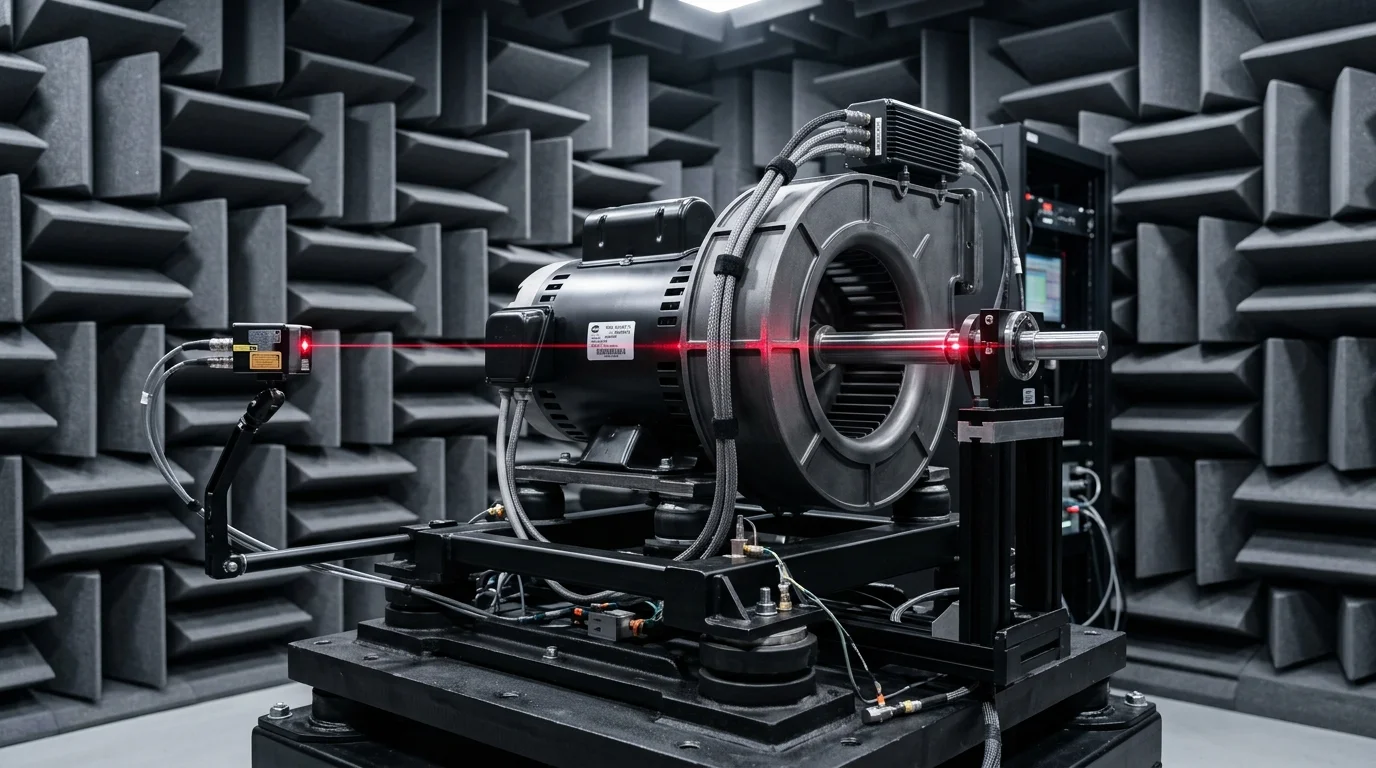
Comprehensive acoustic testing conducted in a hemi-anechoic sound chamber with a background noise floor below 18 dBA validates the acoustic quietness of MYSUN's center-tapped dual-voltage platform:
| Acoustic & Vibration Parameter | Standard OEM Blower Motor | MYSUN Dual-Voltage Quiet Motor | Acoustic Improvement |
|---|---|---|---|
| Total Sound Pressure (SPL @ 1m, 115V 60Hz) | 47.2 dBA | 41.4 dBA | -5.8 dB (Nearly 50% sound energy drop) |
| Total Sound Pressure (SPL @ 1m, 230V 50Hz) | 45.8 dBA | 40.8 dBA | -5.0 dB |
| 120 Hz Fundamental Magnetic Hum | 42.5 dBA discrete peak | <31.0 dBA (Below room noise) | -11.5 dB attenuation |
| Casing Vibration Velocity (RMS, 10–1000 Hz) | 1.85 mm/s (Class B) | 0.68 mm/s (Class A Grade) | 63% reduction in structure-borne vibration |
| Start-Stop Mechanical Transients | Clicking & contact chatter (>55 dBA) | Smooth silent ramp-up (No clicks) | 100% elimination of start-up contact noise |
5. HVAC Equipment Installation & Blower Isolation Guidelines
Even the quietest motor can generate duct noise if improperly coupled to the fan scroll. MYSUN application engineers recommend three critical mechanical best practices for commercial air handler integration:
- Resilient Rubber Belly-Band Isolation: Mount motors using high-durometer EPDM elastomeric isolation grommets or 3-lug resilient ring brackets rather than rigid rigid-base foot mounts to decouple structural vibrations from sheet metal.
- Resonance Frequency Separation: Ensure the natural frequency of the motor-fan bracket assembly ($f_n$) is decoupled by at least $\pm 25\%$ from operating rotational frequencies ($25 ext{–}30 ext{ Hz}$) and electrical harmonic frequencies ($100 ext{–}120 ext{ Hz}$).
- Precision Shaft Alignment: Custom ground shaft diameters with standard 0.500" or 0.625" tolerances (+0.000" / -0.0005") and precision set-screw flats prevent impeller runout and eccentric aerodynamic whistle.
6. Engineering Collaboration & Rapid Prototype Sampling
Guangdong MYSUN Power Technology Co., Ltd. provides customized acoustic engineering support for global HVAC OEMs. Send us your target sound criteria (dBA / NC curves), impeller dimensions, and voltage parameters for custom prototyping and anechoic test verification.
Have a Dual-Voltage (115V/230V) HVAC Requirement?
Guangdong MYSUN Power Technology Co., Ltd. custom engineers commercial HVAC BLDC and AC motors with solid-state center-tapped windings, eliminating centrifugal switches and capacitor burnouts. Engineering proposals delivered in 14–30 days; rapid prototyping batches confirmed following engineering review.