Thermal Dissipation & Structural Reliability in Heavy-Payload UAV BLDC Motors: Mitigating High-Ambient Thermal Throttle
Technical evaluation of thermal throttling, irreversible magnet demagnetization, and stator coil thermal limits in 20–100kg heavy-payload UAVs under 45°C+ ambient environments. Features centrifugal active cooling, 0.2mm laminations, and 220°C VPI insulation.
Thermal Management in Industrial & Agricultural Heavy-Payload UAVs
Commercial unmanned aerial vehicles (UAVs) configured for heavy payloads—such as 30–80 kg agricultural crop sprayers, logistics cargo multirotors, and autonomous firefighting drones—place extraordinary thermal and structural demands on brushless DC (BLDC) outrunner motors. Unlike recreational drones operating short 10-minute sprint missions, heavy-lift industrial drones must maintain continuous hover duty cycles under intense solar radiation and high ambient temperatures often exceeding 40°C to 48°C.
Under these sustained high-current operating conditions, thermal throttling becomes the critical bottleneck limiting flight time, payload capacity, and flight safety. A failure in thermal management triggers a cascading sequence of physical degradation: copper winding resistance rises exponentially, stator insulation degrades, and permanent magnets suffer irreversible demagnetization. This engineering paper analyzes the core heat dissipation mechanisms and outlines MYSUN's high-reliability propulsion architecture for OEM multirotor builders.
1. The Physics of High-Temperature Thermal Runaway
In high-thrust BLDC motors drawing continuous currents from 60A to over 140A per arm, the primary heat generator is copper stator winding resistive loss (\(P_{\text{copper}} = 3 I_{\text{rms}}^2 R_{\text{phase}}\)). Because the electrical resistivity of copper exhibits a positive temperature coefficient (\(\alpha \approx +0.00393 / ^\circ\text{C}\)), winding resistance scales linearly with operating temperature:
Copper Resistance Thermal Compounding Formula:
$$R(T) = R_{20} \cdot \left[ 1 + \alpha_{20} (T - 20^\circ\text{C}) \right]$$ At an operating temperature of \(120^\circ\text{C}\), winding resistance increases by approximately 39.3% compared to room temperature. This substantial increase causes resistive dissipation to spike by the exact same proportion, generating a compounding thermal feedback loop that accelerates thermal runaway if passive cooling is inadequate.
Concurrently, iron core losses (\(P_{\text{iron}} = P_{\text{hysteresis}} + P_{\text{eddy}}\)) multiply rapidly at high electrical fundamental frequencies (400–800 Hz in high-pole-count multirotors). In unoptimized stators fabricated with standard 0.35mm or 0.50mm electrical steel, excessive eddy currents generate supplementary heating localized within the stator tooth tips.
2. Magnetics: Preventing Irreversible Demagnetization of NdFeB Magnets
Sintered Neodymium-Iron-Boron (NdFeB) permanent magnets possess high remanence (\(B_r\)) and energy product (\((BH)_{\text{max}}\)), enabling the high torque density required by commercial multirotors. However, their intrinsic coercivity (\(H_{cj}\)) drops markedly as temperature rises, with a negative temperature coefficient (\(\beta \approx -0.50\% \text{ to } -0.60\%/^\circ\text{C}\)).
If stator winding hotspots elevate internal rotor cavity temperatures beyond the magnet grade's maximum working limit (\(T_{\text{max}}\)), the operating load line shifts below the "knee" of the second-quadrant demagnetization curve. Once this occurs:
- Irreversible Flux Loss: The magnet permanently loses a portion of its magnetic field strength, causing motor velocity constant (\(K_v\)) to shift higher and torque constant (\(K_t\)) to plummet.
- Compounding Current Demand: To maintain the same hover thrust, the flight controller must supply even higher phase current, driving the motor deeper into thermal runaway until catastrophic phase blowout or mid-air ESC shutdown occurs.
To eliminate this vulnerability, MYSUN Heavy-Payload UAV motors exclusively employ SH, UH, and EH grade NdFeB magnets (operating limits from 150°C to 200°C) stabilized by heavy dysprosium (Dy) and terbium (Tb) grain boundary diffusion, ensuring complete magnetic stability even during peak emergency power surges.
3. Centrifugal Active Airflow Rotor Architecture
Traditional enclosed bell housings restrict convective heat exchange, trapping stagnant air within the airgap. MYSUN engineers resolved this challenge by developing an integrated centrifugal airflow cooling bell:
Centrifugal Blade Geometry
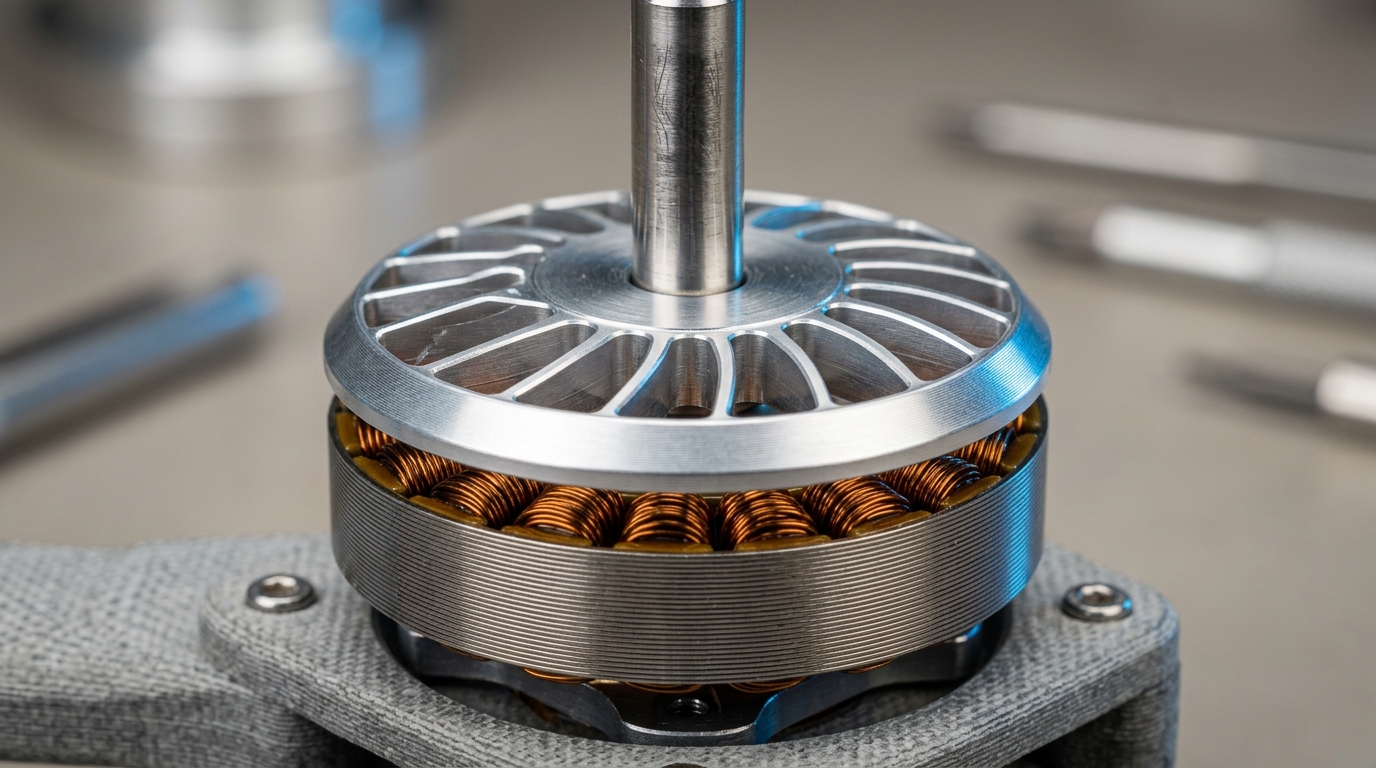
CNC-machined directly into the upper titanium-aluminum rotor dome, precision aerodynamic impeller vanes draw high-velocity cooling air downward directly over the exposed stator end-windings, creating a continuous negative pressure gradient that evacuates heat through bottom exhaust apertures.
Class 220 (C-Grade) VPI Vacuum Impregnation
Windings are insulated using ultra-high-temperature polyamide-imide enameled copper and encapsulated via automated vacuum pressure impregnation (VPI). Void-free resin fills all inter-turn air pockets, boosting thermal conductivity directly to the core and establishing IP55 dust and pesticide spray resistance.
4. Engineering Benchmark: Heavy-Lift UAV Motor Comparison
| Engineering Metric | Off-the-Shelf Hobby Outrunner | Standard Commercial UAV Motor | MYSUN Heavy-Lift Thermal BLDC |
|---|---|---|---|
| Silicon Steel Lamination Thickness | 0.35 ~ 0.50 mm (Standard) | 0.25 mm | 0.20 mm Ultra-Thin (Low Loss) |
| Magnet Grade / Thermal Limit | N42 / 80°C ~ 100°C | N45SH / 150°C | N48UH / 180°C Demag-Proof |
| Stator Coil Temperature Rise (ΔT) | +85°C ~ +105°C (High Throttle) | +65°C ~ +75°C | +42°C ~ +48°C (Active Venting) |
| Winding Wire Thermal Class | Class 155 (F) | Class 180 (H) | Class 220 (C-Grade VPI) |
| Rotor Bell Material & Balance | 6061-T6 / G6.3 Dynamic | 7075-T6 / G2.5 Dynamic | Aeronautical 7075-T6 / G1.0 Precision |
5. OEM Selection & Propulsion Integration Guidelines
When sizing propulsion powertrains for agricultural spraying drones (e.g., DJI Agras or XAG platforms) or long-range logistics multirotors, OEM propulsion engineers should observe the following guidelines:
- Continuous Hover Sizing at 50%–60% Throttle: Ensure that continuous hover current operates below 60% of the motor's maximum continuous thermal rating. This leaves ample thermal headroom for gust stabilization and rapid payload descent recovery.
- Matching Kv with Propeller Pitch-to-Diameter: Large-diameter carbon fiber folding propellers (30" to 48") yield the highest figure of merit (g/W) when matched to ultra-low Kv motors (80–120 Kv) powered by 12S to 24S LiPo / Solid-State battery packs.
- Environmental Sealing vs Airflow Trade-Off: In agricultural spraying operations involving caustic chemical mists, specify internal conformal VPI coating with IP55 labyrinth bearing seals to protect ball bearings while preserving full centrifugal thermal airflow.
Custom Heavy-Lift Drone Motors from MYSUN
Guangdong MYSUN Power Technology Co., Ltd. partners with global drone manufacturers to develop custom BLDC outrunners ranging from 80mm to 160mm outer stator diameters. With in-house winding, CNC turning, magnet assembly, and dynamic balancing chambers, we provide prototype samples in 14–30 business days.
Ready to Optimize Your Motor Performance & Lower TCO?
Guangdong MYSUN Power Technology Co., Ltd. delivers customized BLDC, EC, and high-torque geared motor solutions tailored to your thermal, mechanical, and efficiency specs. Engineering proposals in 14–30 days; prototype batches (3–5 units) and production timelines confirmed following engineering review.